
How to find long lost relatives starts with what you already know. That may be a name, a town, and a rough age. From there, records, family memory, and free tracing services can close most of the gap.
Families drift apart for ordinary reasons. A move abroad, a divorce, a quarrel, or a death that broke the last link. Years pass, and nobody has an address for a family member you lost contact with.
At Low Cost Detectives, we have traced people for over 30 years in 170+ countries. This guide shows how to find long lost relatives, step by step, and how to reach out.
Key Takeaways
- Learning how to find long lost relatives starts with the details your family already holds.
- Records, social media, and DNA tests show how to find a lost family member at little cost.
- In the UK, several charities trace family members for free, within set criteria.
- First contact is the other person’s choice. A gentle approach gives the best chance of a reply.
How to Find Long Lost Relatives: What to Gather First
Anyone asking how to find long lost family members should first collect everything they can. Small details decide whether a search finds the right person. People who share a name are easy to confuse without a date of birth.
Write down what you know, even if it is a guess:
- Full name, including middle names, maiden names, and nicknames.
- Date of birth, or at least the birth year.
- Last known address, town, or country.
- Family links: parents, siblings, a spouse, or children who might be easier to find.
- Work and school: employers, trades, or schools they attended.
- Old photographs and letters, which can hold dates, places, and other names.
Asking around the family is the first lesson in how to find long lost relatives. Older relatives often remember more than they expect, once they see an old photo. Ask the extended family too. An aunt or cousin may have kept a Christmas card or an old address book.
Free Ways to Find a Lost Family Member
When working out how to find long lost relatives, start with routes that cost little or nothing. It takes patience, so keep notes as you go.
- Family and friends. Ask everyone who knew the person. One cousin’s phone number can unlock a whole branch of the family tree.
- Social media. Search the name with a town, a school, or a maiden name. Look at the friends lists of other relatives too.
- Public records. Birth records, marriage records, and death records can show a new surname or a new town. In the UK, the General Register Office holds records “registered in England and Wales from July 1837.” That is according to GOV.UK guidance on family history records.
- Newspapers and archives. Local newspapers, obituaries, and archives can name surviving family members.
- Consumer DNA tests. A test can match you with relatives who have also tested, such as cousins or distant relatives. It works only if they have tested too.
Records go out of date because people move. The US Census Bureau found that 11.8 percent of Americans moved in 2024. Confirm any address with a second source before you write. Our guide to the free ways to look up an address covers more methods.
Looking for a friend, not family? See our guide to finding an old friend after decades. If you fear a relative is in danger, contact the police first.
Which Family Tracing Services Can Help for Free?
If you are wondering how to find long lost relatives in the UK, start with its free services. Each helps people find lost family members, with its own rules. The infographic below compares them.
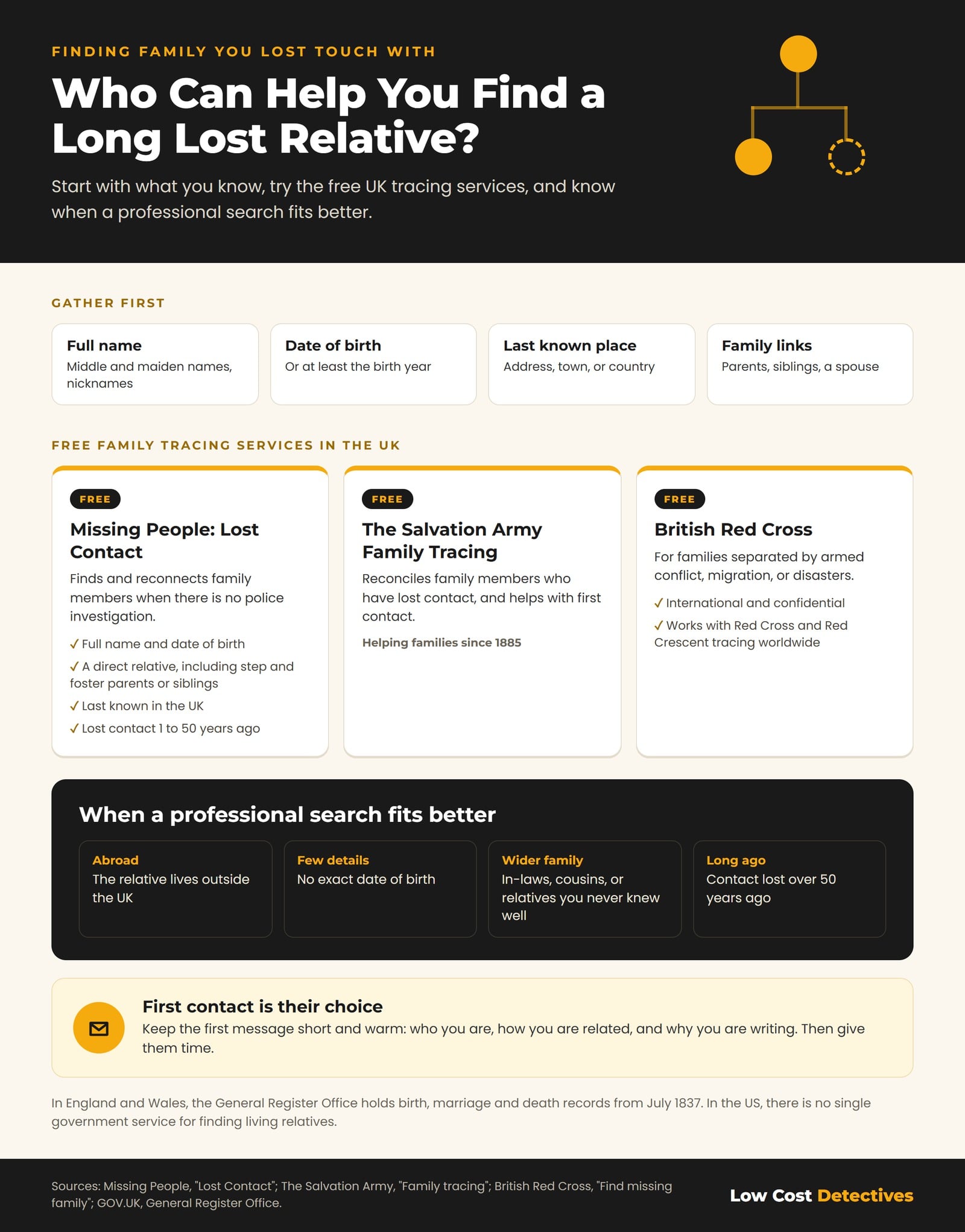
Missing People’s Lost Contact service. The charity runs a free Lost Contact service “to help you find and reconnect with a family member.” You need the relative’s full name and date of birth. They must be a close relative, which can include step and foster family. Their last known location must be in the UK. Contact must have been lost for at least a year, and within the past 50 years.
The Salvation Army. The Salvation Army Family Tracing Service has worked since 1885. It describes the search honestly:
“Searching for a relative is often an emotional experience.”
The British Red Cross. Its family tracing service helps families who lost contact “because of armed conflict, migration, and disasters.” It says the international service “is free and confidential.”
In the US, there is no single government service for finding living relatives. Most searches there rely on records, family networks, and private help.
When to Ask a Professional, and How to Make First Contact
Sometimes the free routes do not fit. That is where a professional search helps. That often means a relative abroad, no exact date of birth, or contact lost long ago. It also covers relatives the charities cannot take, such as in-laws, cousins, or relatives you never knew well.
At Low Cost Detectives, our people tracing investigators start from a name or a strong lead. They use open-source research, databases, field inquiries, and locally employed agents. Then they confirm the address before reporting it. For family overseas, we handle tracing relatives in another country. Not sure your case fits? Talk to our team in confidence.
We do not offer DNA testing, and we do not build family trees. Every search is discreet:
“The subject is never alerted or approached unless the client specifically requests contact facilitation.”
Making First Contact
Finding a relative is one step. Hearing back is another, and it is their choice. Keep the initial message short and warm. Say who you are, how you are related, and why you are getting in touch. Then give them time.
Some relatives reply quickly. Some need weeks, and some never reply. If you want help, we can make a careful first approach on your behalf. The relative then decides whether to answer.
Bringing a Lost Branch of the Family Back Into Touch
You now know how to find long lost relatives with what you already have. Gather the details, ask the family, and work through the records. Try the free tracing services if your case fits. Then reach out gently. Not every search ends in a reunion, and that is all right.
If the trail runs cold, Low Cost Detectives can help. We work in 170+ countries with a 95% global success rate. Speak to our case managers about your search. Every inquiry is handled in confidence.
Frequently Asked Questions About Finding Long Lost Relatives
How do you find a lost family member for free?
Start with family members and friends who knew them. Search social media with a name and a town. Check birth, marriage, and death records, and old newspapers. In the UK, Missing People and the Salvation Army trace relatives for free. Your case must meet their criteria.
How can you find long lost relatives in the UK?
Gather the full name and date of birth first. Then check General Register Office records and ask the family. Missing People’s Lost Contact service and the Salvation Army Family Tracing Service can help for free. The British Red Cross helps where conflict, migration, or disaster separated a family.
Can you find a relative with only a name?
Sometimes. Knowing how to find long lost relatives with only a name comes down to detail. A common name is hard to search alone. Add a birth year, a town, a school, or a parent’s name. Older relatives can often fill gaps. Some free services need an exact date of birth. A professional search can work from less.
Can a DNA test find lost relatives?
It can, if your relatives have also tested. The test lists likely matches, often cousins rather than close family. From there, genealogy research shows how each match connects to you. A match gives you a lead, not an address. You still need to find where the person lives now.
What if a relative does not want contact?
That is their right, even when it hurts. Some people cut contact for reasons you may not know, and their privacy matters. Send one kind message and leave the door open. Do not keep writing or turn up at their home. A careful first approach through a third party can make a reply easier.
Can a private investigator find a lost family member?
Often, yes, especially when you have a name and some background. At Low Cost Detectives, investigators search records and make discreet local inquiries, including abroad. They confirm a current address before reporting it. If you ask, we can make a careful first approach on your behalf.