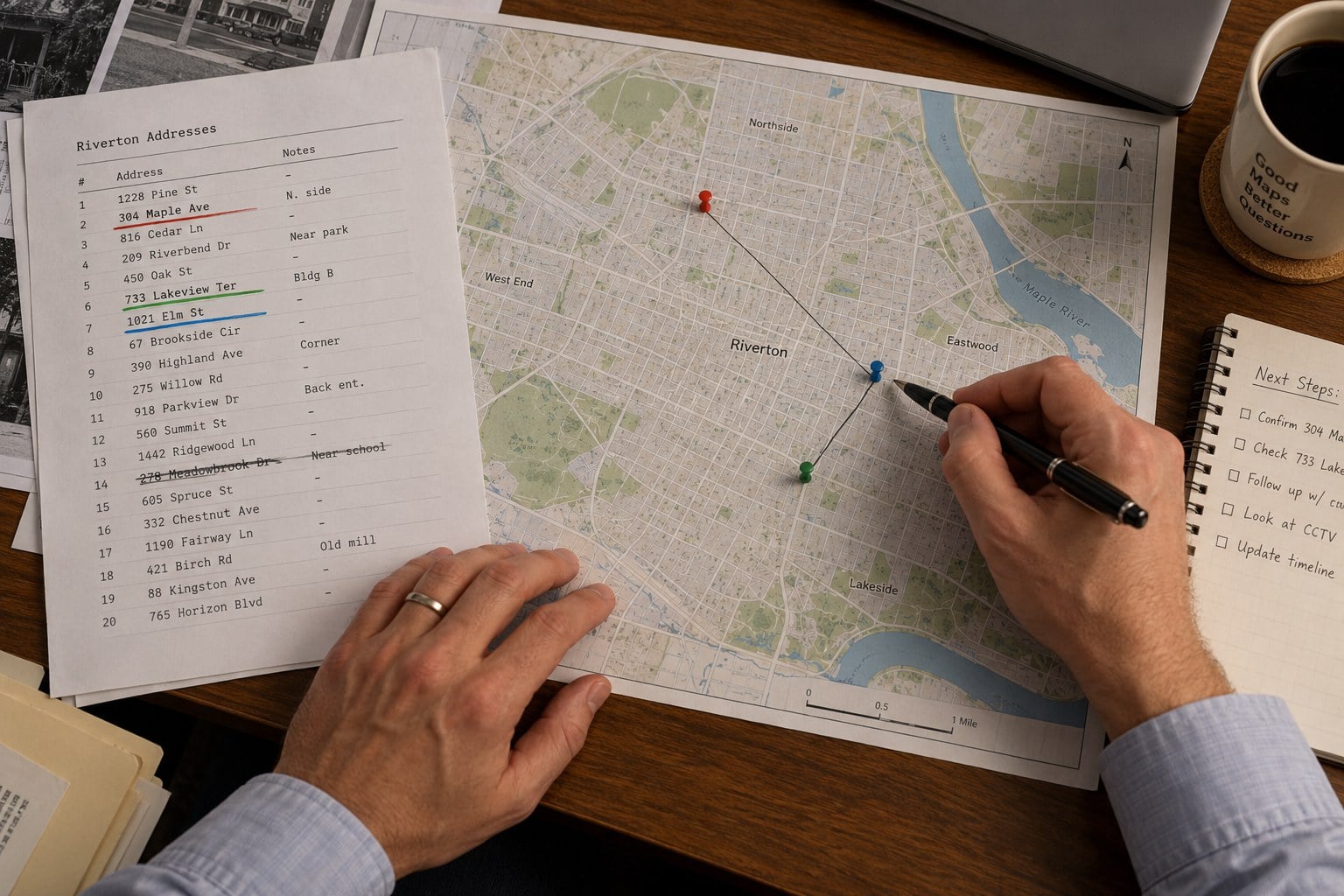

How to find the owner of a property is usually a public records question. In the United States, the county holds the answer.
Tax records give you a name quickly, and deed records confirm it. The harder part often comes later. The name may belong to a company, or lead to an address the owner left years ago.
At Low Cost Detectives, we have traced people for over 30 years in 170+ countries. This guide to how to find the owner of a property covers the free records first. Then it covers what to do next.
Key Takeaways
- How to find the owner of a property starts with county tax and deed records. Both are free to search.
- In England and Wales, HM Land Registry holds the title register.
- A name is not always a person. Many properties are held by an LLC, a trust, or an estate.
- If the owner has left the address on file, skip tracing can find them.
How to Find Out Who Owns a Property Using Public Records
Property ownership is public in most places. To learn how to find out who owns a property, start with the county where it sits. Two county offices hold the property records you need. One collects property tax. The other keeps the recorded deeds. Office names differ from state to state.
How to Find the Owner of a Property, Step by Step
- Note the exact address. If you can, find the parcel number too.
- Search the county assessor’s records. Some states call this the tax appraisal office. The tax roll lists the owner’s name, a mailing address, and the assessed value.
- Check the deed records. The county recorder or county clerk keeps the recorded deeds. The latest deed shows the legal owner.
- Read the deed carefully. The grantee is the person who received the property. The grantor is the one who transferred it.
- Ask nearby. Neighbors, tenants, and managing agents often know who to speak to.
This is also how to find property owner by address. Most county sites let you search by street address, and many are free. The California Courts guidance on county records describes the assessor’s tax roll. It holds “the name and address of property owners.”
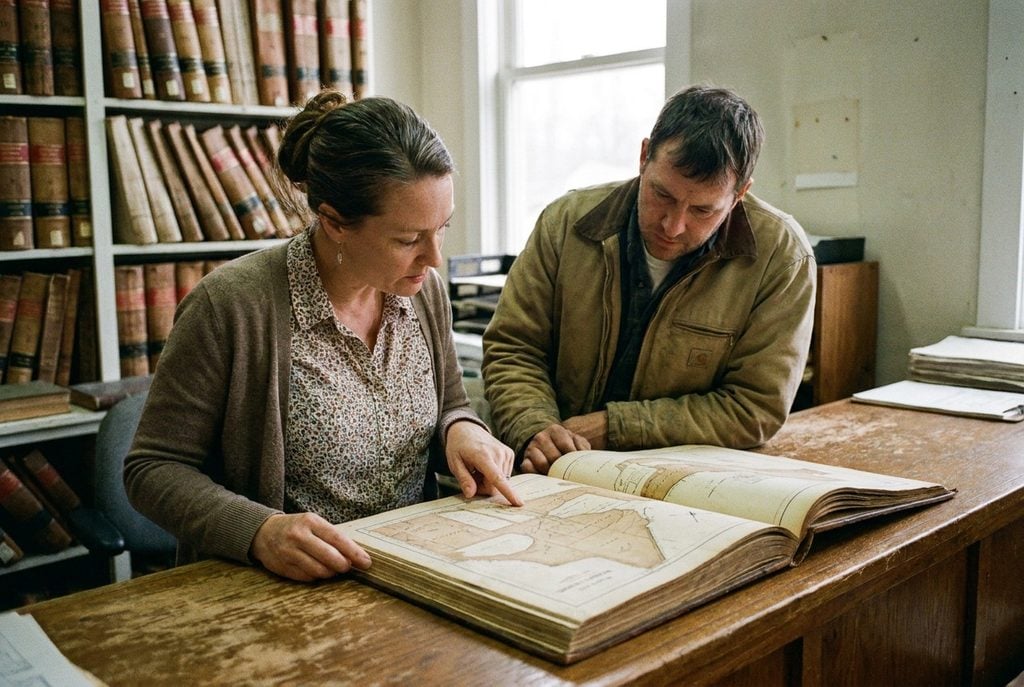
The two record types differ in quality. Texas Tenant Advisor, a nonprofit, publishes a tenant guide to finding who owns a property. It says tax office data “is not always correct, but it is easy to search and free.” It calls deed records the most accurate route, and the most complicated.
Tax records can also be out of date, for example after a recent sale. If the two disagree, trust the deed. A title search goes further. It follows the chain of title and shows the ownership history, with any mortgage or liens.
Tenants have an extra route. In Texas, a landlord must give the owner’s name within seven days of a written request.
| Where to look | What it shows | Main limit |
|---|---|---|
| County assessor or tax appraisal office | The owner’s name and mailing address | Easy and free, but not always up to date |
| County recorder or deed records | The recorded deed and the legal owner | Most accurate, but harder to search |
| State business records | A company’s status and registered agent | Usually not the people behind the company |
| HM Land Registry (England and Wales) | The title register, including who owns the property | Covers registered land only |
Finding Out Who Owns Land or a House in the UK
England and Wales keep one national register. The GOV.UK guidance on property and land opens it to everyone. You can get information on registered property “even if you do not own it.”
The title register shows who owns the property. The title plan shows its location and general boundaries. This is how to find out who owns land or a house there. HM Land Registry charges a small fee for copies. Scotland and Northern Ireland keep separate registers.
What If the Property Is Owned by an LLC, a Trust, or an Estate?
Sometimes the records name a business, not a person. The current owner may be an LLC, a corporation, or a trust. It may also be the estate of someone who has died. That changes how to find the owner of a property. It does not end the search.
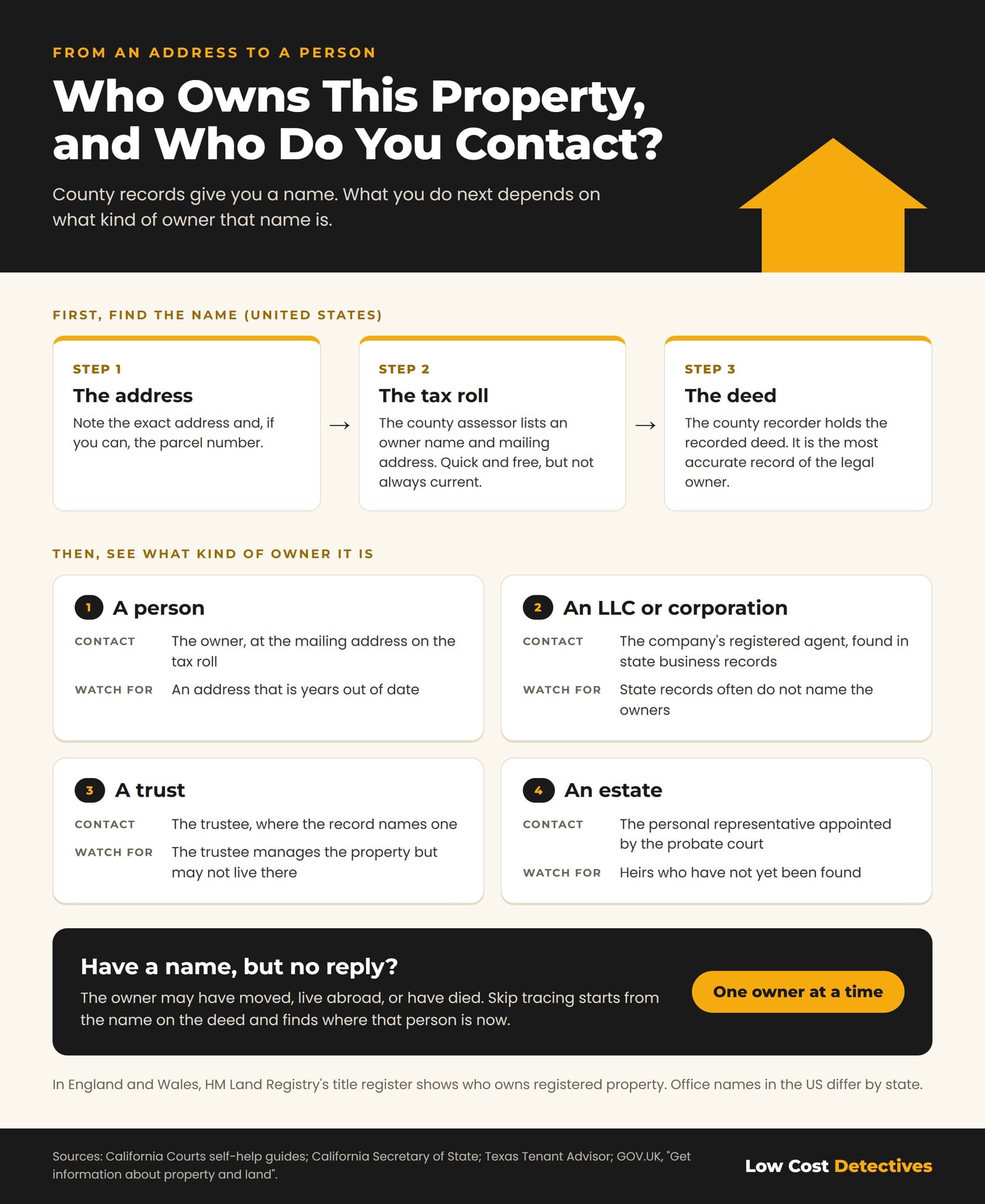
An LLC or corporation. Search the business records of the state where the entity was formed. The secretary of state usually keeps them. You will normally find the company’s status and its registered agent. A registered agent accepts legal documents for the company. That gives you a lawful address for formal letters.
Do not expect the owners’ names. On this point, the California Secretary of State’s guidance is direct. Owner information “is not made of record with the California Secretary of State.” Other states often work the same way.
A trust. A trustee manages property held in a trust. Where the record names the trustee, write to that person.
An estate. If the homeowner has died, the property may go through probate. The California Courts explain that a judge appoints a personal representative. That person represents the estate, so they are the one to contact. Sometimes the heirs have never been found. In that case, our people tracing investigators can help locate them.
A buyer about to deal with a company may need more than a name. Our team can run checks on a company and its owners.
Why Can You Not Reach the Owner Even When You Have a Name?
Knowing how to find the owner of a property gets you a name. It does not always get you a reply. The mailing address on the tax roll can be years old. Records carry no phone number or other contact information.

People move often. The US Census Bureau found that 11.8 percent of Americans moved in 2024. Records do not always keep up. These are the usual reasons a letter goes unanswered:
- An outdated mailing address. The owner moved and never updated the county.
- An absentee owner. A rental or vacant lot may be owned by someone in another state.
- An owner abroad. Some owners live in another country and rarely visit.
- A death in the family. The owner has died, and the heirs have not updated the title.
There is more to how to find a property owner than records. Write to the mailing address and to the property itself. Our guide to the free ways to look up an address covers the next steps.
Keep it reasonable. Repeated unwanted contact can become harassment, whatever your reason. If the owner still cannot be found, talk to our team in confidence.
How Skip Tracing Helps Locate a Property Owner
Skip tracing is the process of finding a person who has moved without leaving contact details. For property, it starts where the public records stop. You bring the owner’s name from the deed. The trace finds where that person lives now. Our short guide explains what skip tracing involves.
For many readers, this is the missing step in how to find the owner of a property. It helps in situations like these:
- A buyer or real estate agent wants to make an offer on a vacant house.
- A neighbor needs to settle a boundary, a repair, or a safety problem.
- A tenant or managing agent must reach a landlord who has gone quiet.
- A law firm needs to serve papers on the owner, perhaps in a foreclosure.
- An estate has property, and an heir has to be told.
A note on what we do not do. In real estate, skip tracing often means buying bulk lists of owner contact details. Low Cost Detectives does not sell lists. We trace one owner at a time, for a clear and lawful reason.

Our investigators use open-source research, databases, and field inquiries. We also have locally employed agents in the places we work. They confirm the address before they report it. We check the purpose of every case, and we decline any that raises concern. Our service standard is simple:
“The subject is never alerted or approached unless the client specifically requests contact facilitation.”
If the matter is heading to court, see our litigation support for legal teams. If the owner lives overseas, we handle tracing someone in another country. For creditors, agents, and law firms, read about our professional skip tracing support.
From a Name on a Deed to a Person You Can Reach
You now know how to find the owner of a property. Start with the county tax records. Confirm the name in the deed records. Check state business records if a company holds the title.
Some do not. If the name leads to an old address, Low Cost Detectives can find the person behind it. We work in 170+ countries with a 95% global success rate. Speak to our case managers about your situation. Every inquiry is handled in confidence.
Frequently Asked Questions About Finding a Property Owner
How do you find out who owns a property for free?
The free route in how to find the owner of a property is the county’s own records. The assessor or tax office lists an owner name and mailing address for each parcel. The recorder or county clerk’s office holds the deeds. Many counties offer both searches online at no charge. Where they do not, visit or call the office.
How do you find out who owns a house next door?
For how to find out who owns a house near you, search its address in county tax records. If a company is named, check your state’s business records for its registered agent. Asking the occupants politely often works too. A tenant can usually tell you who manages the property.
Who owns this property if it looks abandoned?
“Who owns this property” has the same answer for an empty building. The county tax roll still lists an owner, even when nobody lives there. The mailing address may be in another city or state. If letters go unanswered, the owner may have died or moved. A professional trace can help then.
How do you find out who owns an LLC that owns a property?
Start with the state’s business records. They usually show the company’s registered agent and its filing history. They often do not list the owners. Annual reports sometimes name managers or officers. For a legal matter, a lawyer can advise you on formal ways to request more.
How do you find out who owns land in the UK?
In England and Wales, search HM Land Registry by address or location. The title register shows who owns the land. A title plan shows where it sits. Not all land is registered, so an index map search may be needed. Scotland and Northern Ireland have their own registers.
What is skip tracing in real estate?
It is the last step in how to find the owner of a property. It means locating someone the records cannot reach. Investors often use the term for bulk contact lists. At Low Cost Detectives, we use it differently. Our investigators find property owner by owner, starting from the name on the deed. The result is a confirmed current address.