
What can a private investigator do for you, and what can they do to you? The honest answer is more than most people expect, and less than films suggest.
A private investigator can watch, research, trace, and record, all within the law. They cannot get your phone records, hack your accounts, or arrest you. This guide shows where the line sits. It helps whether you plan to hire one or think one is looking into you.
At Low Cost Detectives, our investigators have worked cases in 170+ countries for over 30 years.
Key Takeaways
- Private investigators watch people in public places, check public records, trace people, and gather evidence for court.
- They cannot get phone records, read texts, tap phones, or hack accounts.
- They have no police powers, so they cannot arrest you or enter your home.
- Most US states require private investigators to be licensed.
- Hiring an investigator is legal when the purpose is lawful.
What Can a Private Investigator Do?
What can a private investigator do day to day? The US Bureau of Labor Statistics describes the core of the job. Investigators “may keep watch through binoculars or take photographs.” They often work “from a hidden position” to gather information on people of interest.
Most cases rely on four kinds of work.
Surveillance in Public Places
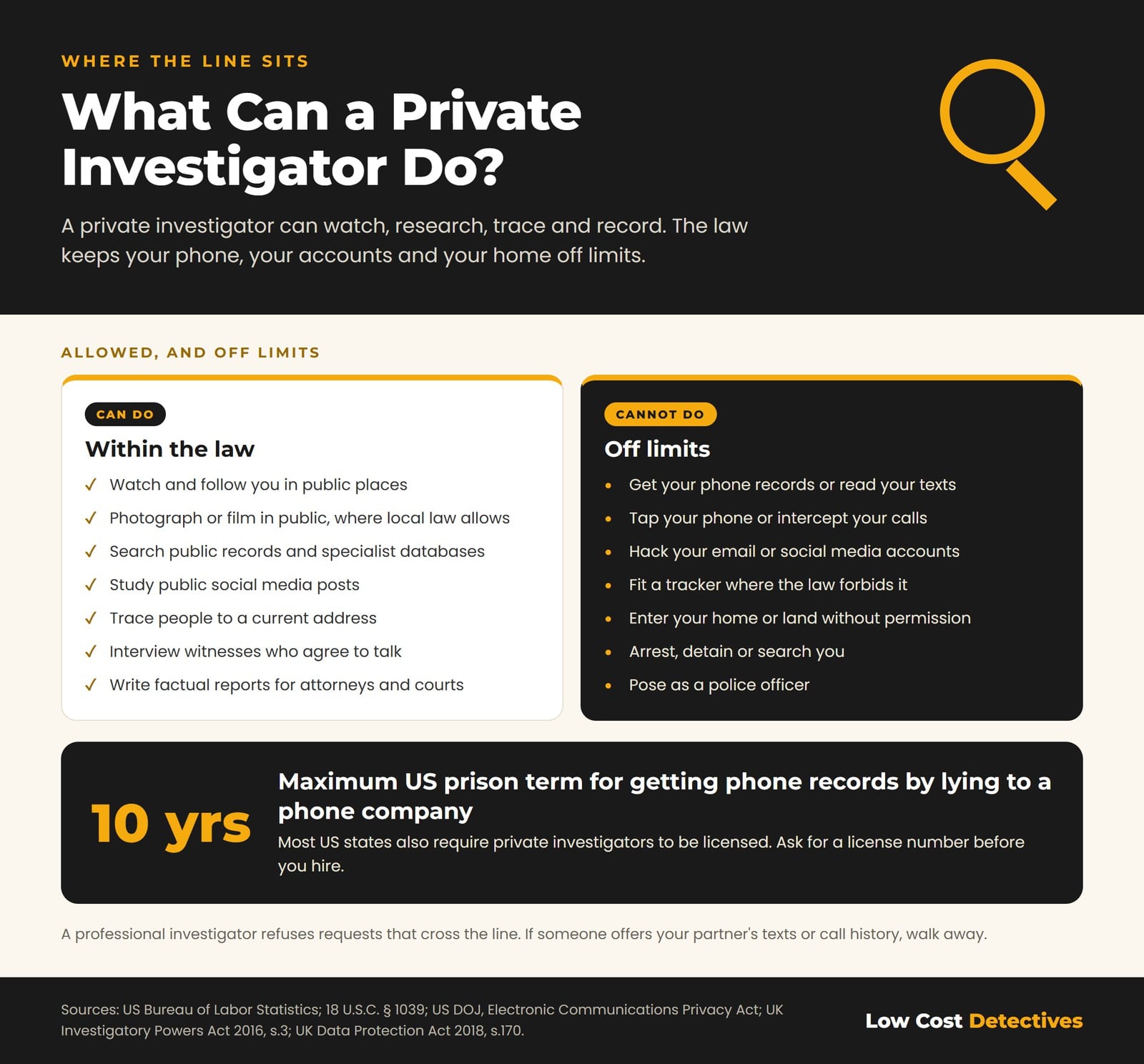
An investigator can watch and follow a person anywhere the public can go. That includes streets, parking lots, shops, restaurants, and gyms. They can record what they see, with photos or video where local law allows.
Our surveillance private investigator teams work in pairs with a vehicle. The subject is never approached or alerted. Some countries do not allow filming people without consent. There, our investigators keep a detailed written log instead.
Background Checks and Public Records
Investigators search public records and specialist databases. These cover addresses, property, company roles, court cases, and criminal records where the law makes them available. They also study social media and other publicly available information.
Our background check investigations confirm whether someone is who they say they are. That matters before a marriage, a business deal, or a new hire.
Finding People
What can a private investigator do in a tracing case? Usually, confirm a current address. Tracing a missing relative, a debtor, or an old friend is everyday work. Investigators combine open-source research, databases, and inquiries on the ground. The people tracing service at Low Cost Detectives uses local agents in 170+ countries.
Interviews and Evidence for Court
What can a private investigator do once a case reaches court? Investigators can interview witnesses who agree to talk. They can photograph public places, collect documents, and write factual, dated reports. Attorneys and solicitors use these reports in divorce, custody, insurance, and employee misconduct cases.
What a Private Investigator Cannot Do
The limits matter as much as the methods. A good investigator stays well inside them, because evidence gathered illegally can sink a case.
Phone Records, Texts, and Phone Tapping
An investigator cannot get your phone records or read your texts. In the US, lying to a phone company for records is a federal crime under 18 U.S.C. § 1039. It carries up to 10 years in prison.
Tapping a phone is off limits too. The federal Wiretap Act “prohibits the intentional actual or attempted interception” of calls and electronic messages. In the UK, unlawful interception is a criminal offense under the Investigatory Powers Act 2016.
Hacking and Private Accounts
Investigators cannot log into your email, social media, or cloud accounts. They cannot install spyware on your phone or guess your passwords. In the UK, taking personal data without consent is a criminal offense under the Data Protection Act 2018.
Low Cost Detectives does not install tracking apps, and we never access anyone’s phone, messages, or accounts.
Trackers and Trespass
Many places restrict GPS trackers. California, for example, bans tracking a person with an electronic device unless the vehicle’s owner consents. Investigators also cannot trespass. They cannot enter private property, such as your home, garden, or office, without permission.
Arrests and Posing as Police
A private investigator has no police powers. They cannot arrest, detain, or search you. Only law enforcement can do that. They must not pretend to be a police officer or carry a fake badge. If they find evidence of a crime, they can pass it to their client or the police.
What Can a Private Investigator Find Out About You?
What can a private investigator do with your details? More than you might think. Much of it comes from public sources alone. An investigator can often confirm where you live and work. They can find property you own, companies you run, and court cases in your name.
Your public posts, photos, and tagged locations are fair game. Surveillance can show where you go and who you meet in public.
What stays private? Your phone records, messages, bank statements, and medical files. An investigator cannot see them without your consent or a court order.
Is It Legal to Hire a Private Investigator?
Yes. Hiring an investigator is legal when the purpose is lawful. People hire us to check a partner, trace a relative, or test an insurance claim. Businesses hire us to look into fraud or a new partner. Our infidelity investigator service is one of the most common requests.
So what can a private investigator do for you, and what will they refuse? A professional will say no to anything that crosses the line. That includes reading messages, planting trackers, or harassing someone. If an investigator offers your partner’s texts or call history, walk away.
In the US, most states require investigators to be licensed, according to the Bureau of Labor Statistics. Ask for a license number before you hire. At Low Cost Detectives, our investigators are fully licensed, with over 30 years of professional experience.
Worried that someone is listening in on you instead? Our bug sweeping team checks homes, offices, and vehicles for hidden devices. Speak to our investigators in confidence.
A Good Investigator Works Inside the Line
What can a private investigator do, in one sentence? Everything a careful, patient observer can do in public, and nothing the law reserves for the police.
That line protects you whichever side of it you stand. Low Cost Detectives works inside it in 170+ countries, with a 95% global success rate. Contact us in confidence to talk through your case.
Frequently Asked Questions: What Can a Private Investigator Do?
Can a private investigator get your phone records?
No. Phone companies may only release records as the law requires or with the customer’s approval. In the US, getting phone records by lying to a carrier is a federal crime. Records can come out in a court case through a legal order. An investigator cannot simply request them.
Can a private investigator arrest you?
No. A private investigator has no police powers, so they cannot arrest, detain, or search you. They must not pretend to be police or carry a fake badge. If a case turns up evidence of a crime, they can share it with the client or police.
Can a private investigator put a tracker on your car?
Often not. Many places restrict GPS trackers. California, for example, bans tracking a person with an electronic device unless the vehicle’s owner consents. Rules differ by state and country. Our surveillance relies on trained investigators watching in public places, not on hidden devices.
What can a private investigator find out about you?
Anything in public view or public records. That includes your address, work, property, companies, court cases, and public posts. Surveillance can show where you go and who you meet in public. Your phone records, messages, and bank statements stay private without consent or a court order.
Do private investigators need a license?
In the US, most states require private investigators to be licensed, according to the Bureau of Labor Statistics. Rules differ by state, so ask for a license number before you hire. Rules also vary by country. Our investigators are fully licensed, with over 30 years of professional experience.
Is it legal to hire a private investigator?
Yes, when the purpose is lawful. People hire investigators to check a partner, trace a relative, or gather evidence for a case. A professional will refuse anything that crosses the line, such as reading messages. You decide what happens with the findings once the work is done.