

Hidden assets in divorce share one weakness: the money still gets spent. A spouse can move savings into a relative’s name, delay a bonus or claim their business is struggling. What is harder to disguise is how they live. Their car, the property they stay at and the trips they take all leave a visible trail.
That is the idea behind lifestyle surveillance. Investigators document how a spouse actually lives, then compare it with what they declare. Combined with asset tracing, it can turn a suspicion about hidden assets in divorce into usable evidence. At Low Cost Detectives, we combine both in divorce cases where the figures do not add up. This guide explains how assets are hidden, what the law expects, and how surveillance and tracing work together.
Key Takeaways
- Hiding money is common: 39% of US adults with combined finances admit hiding money from a partner.
- Both spouses must disclose: in England and Wales, full and frank disclosure covers everything relevant.
- Lifestyle exposes the gap: spending, property and business activity often contradict a spouse’s declared means.
- Courts have real powers: they can draw inferences, transfer assets held through companies, and reopen settled orders.
- Evidence must be lawful: surveillance records what happens in view, while bank records come through the court.
How Spouses Hide Assets in Divorce
Hiding assets in divorce usually starts before anyone files. Concealment is more common than many people assume. A 2021 Harris Poll survey for the National Endowment for Financial Education (NEFE) shows how often it happens. Among adults with combined finances, 43% admitted some financial deception. Some 39% had hidden a purchase, bank account, statement, bill or cash from their partner.
When a marriage is ending, the stakes rise and the methods become more deliberate. The patterns that come up most often are familiar to family lawyers:
- Underreported income: a self-employed spouse whose business suddenly “slows down” as the divorce begins.
- Assets in other names: property, cars or shares held by a relative, a friend or a new partner.
- Company structures: wealth kept inside a business the spouse controls, sometimes offshore.
- Timing tricks: bonuses, contracts or sales delayed until after the settlement.
- Transfers and cash: money moved out shortly before filing, or kept outside the banking system altogether.
Each method changes where the money sits on paper. None of them changes the fact that the spouse still wants to use it. That is why hidden wealth so often shows up in daily life.
The Duty to Disclose, and Why It Matters
Before looking at evidence, it helps to understand what each spouse owes the court. In England and Wales, both parties must set out their finances in detail. In Sharland v Sharland, the Supreme Court called it a “duty to make full and frank disclosure.” It covers all relevant information, given to each other and to the court.
The United States has its own versions of the same principle. California, for instance, treats spouses as owing each other a fiduciary duty, which includes disclosing assets. The details vary by state and by country. The common thread is simple. A spouse who hides assets is breaking a legal obligation, and that changes how a court treats them.
The Lifestyle Gap: Why Spending Gives Hidden Wealth Away
Every financial statement tells a story about how much a person has. Their lifestyle tells another. When the two do not match, that difference is often the best lead to hidden assets in divorce. Forensic accountants call the paper version of this a lifestyle analysis: comparing declared income with actual spending.
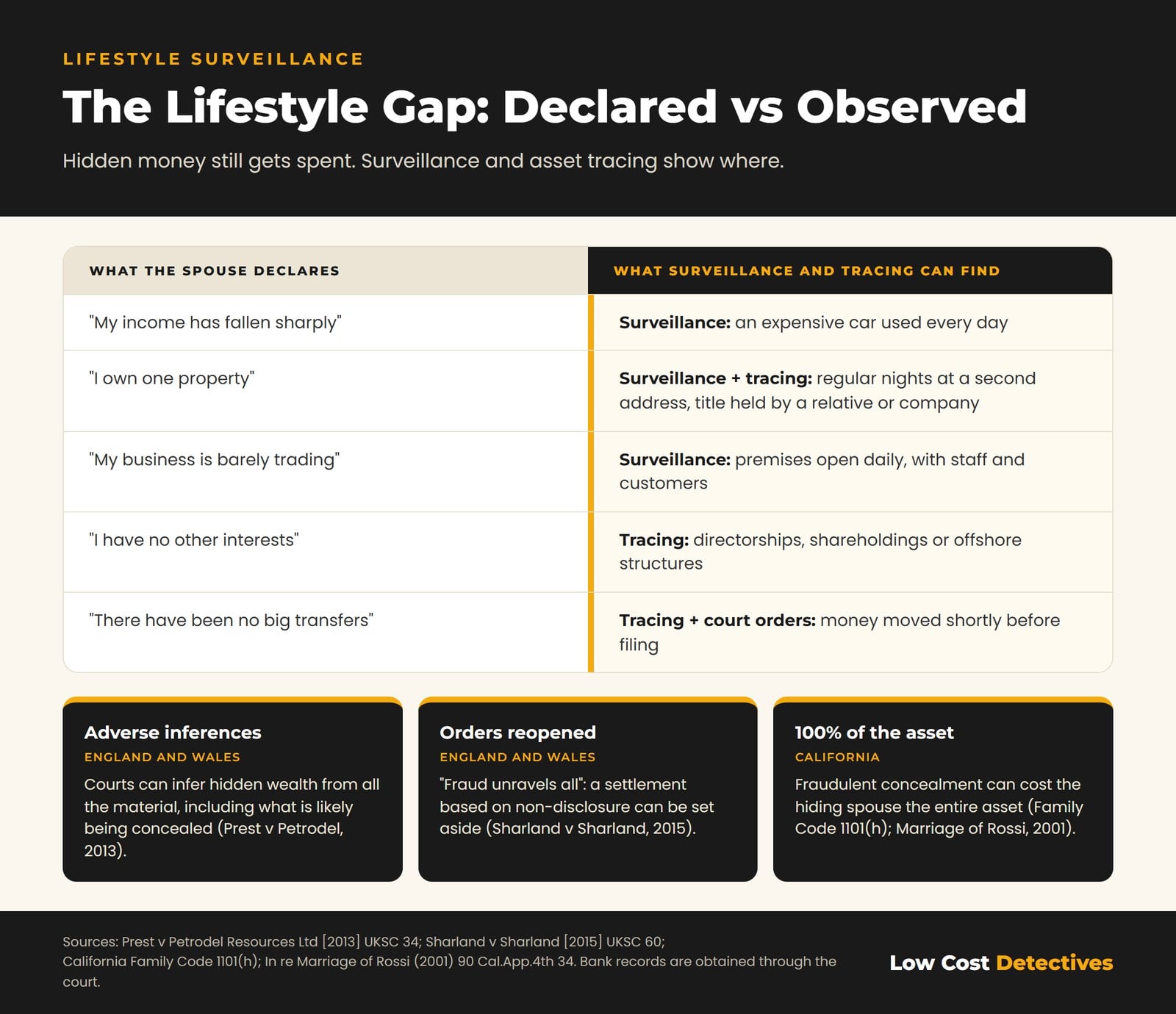
Lifestyle surveillance adds the real-world version. A spouse may declare a modest income but still drive an expensive car every day. They may claim their company is barely trading while its premises stay busy. They may list one home yet spend most nights somewhere else. Each of these is a gap between what they say and what they do.
Certain warning signs suggest a gap worth investigating:
- A sudden drop in declared income or business profits as the divorce begins
- Spending, travel or gifts that the disclosed figures cannot explain
- A new partner, relative or company that seems to fund a comfortable life
- Vague answers about a property, a vehicle, a boat or an overseas account
- Pressure to settle quickly, before full disclosure is complete
None of these proves anything on its own. However, together they justify looking more closely, and that is where surveillance comes in.
What Lifestyle Surveillance Records
Lifestyle surveillance documents how a spouse actually lives, over a set period, from places investigators may lawfully be. It is one of the most practical ways to find hidden assets in divorce. Low Cost Detectives uses two investigators and a dedicated vehicle. Our surveillance team typically works over three days or nights. Every observation goes into a dated log, with photographs and video where local law allows.
Cars, Properties and a “Struggling” Business
The most useful observations are usually ordinary ones, repeated over several days. Surveillance can show which vehicles a spouse uses, and where they park them overnight. It can show regular visits to a property that does not appear in their disclosure. It can also show a busy business, with staff and customers, while its owner claims it is failing.
These details matter because each one points somewhere specific. A car seen every morning can be checked against vehicle records. An address visited every weekend can be checked against property ownership. In that way, surveillance turns a general suspicion into concrete questions with answers.
Filming a High Net Worth Lifestyle Lawfully
In high net worth cases, the lifestyle itself is often the evidence. Think of a marina, a private members’ club or frequent first-class travel. Filming a high net worth lifestyle must still stay within the law. Investigators record what happens in view. They do not enter homes or hotel rooms, read private messages or access bank accounts. In some countries, filming people is not allowed, so investigators keep a detailed written log instead.
Low Cost Detectives works through 300+ branches in 170+ countries. That matters when the lifestyle in question includes a villa abroad or regular trips overseas. Local teams can document what happens there, and reports always arrive in English.
Pairing Surveillance With Covert Asset Tracking
Surveillance shows how a spouse lives. Asset tracing shows what they own, and through whom. That combination is what we mean by covert asset tracking in divorce. Together, they give the clearest picture of hidden assets in divorce.
Our asset tracing investigations search records that can legally be accessed. These include property titles, company directorships and shareholdings, beneficial ownership, vehicles, boats and aircraft. They also include offshore structures and transfers designed to move assets out of reach. The findings come in a report formatted for use in legal proceedings.
The two methods feed each other. Surveillance might show a spouse arriving every weekend at a house they say they do not own. Tracing then checks who holds the title, perhaps a relative or a company they control. Equally, tracing might find an unexplained directorship, and surveillance can show whether that business is active.
Some information, though, needs the court’s help. A private investigator cannot lawfully obtain someone’s bank statements. Instead, your lawyer can use the findings to ask the court to order disclosure. Investigators supply the leads, and the court provides the power to compel the documents. Our divorce investigations are built around that working relationship with your legal team.
What Courts Do When Assets Are Hidden
Once hidden assets in divorce come to light, the consequences can be serious. Courts on both sides of the Atlantic have shown they will act, sometimes dramatically.
In England and Wales, a court does not need a spouse’s cooperation to judge their wealth. In Prest v Petrodel, the Supreme Court said it may draw “such inferences as can properly be drawn.” It can rely on “all the available material.” That includes “judicial experience of what is likely to be being concealed.” In the same case, seven properties in the husband’s companies were held on trust for him. The companies were ordered to transfer them to the wife.
Hidden wealth can also undo a settlement that seemed final. In Sharland v Sharland, the husband’s evidence said there were no plans to float his software company. Press reports later suggested a flotation valuing it at between 750 million and 1 billion US dollars. The Supreme Court held that “fraud unravels all” and allowed the wife’s appeal. The case went back to court.
In the United States, penalties can be even more direct. California’s Family Code section 1101(h) covers concealment that amounts to fraud. It lets a court award the other spouse 100% of the hidden asset. In In re Marriage of Rossi, a wife hid about 1.3 million dollars in lottery winnings. The court awarded all of it to her ex-husband, and the decision was upheld on appeal.
The lesson for anyone suspecting concealment is encouraging. Courts are not powerless when a spouse lies, but they need evidence to act on. Lawful, well-documented findings give them that.
From Suspicion to Settlement: A Four-Step Plan
Bringing all of this together, cases involving hidden assets in divorce tend to follow the same broad sequence. Each step builds on the last, and none should be rushed.
Step 1: Spot the Signs and Keep Notes
Write down what you have noticed, with dates. Note the new car, the unexplained trips, or the business that is suddenly “failing”. Keep copies of anything you already have lawful access to. However, do not search your spouse’s private papers, phone or accounts. In Imerman v Tchenguiz, the Court of Appeal noted the power to exclude evidence “if unlawfully obtained.” If you are unsure what is safe, talk to our team in confidence first.
Step 2: Document the Lifestyle
Once your lawyer agrees the gap is worth pursuing, lifestyle surveillance can document it. Timing matters. The most revealing days are often those a spouse thinks no one is watching. Weekends, holidays and the weeks around court dates are typical. Our matrimonial surveillance service plans the days around what you already know. If the lifestyle seems funded through a new partner’s home, our cohabitation investigations address that question too.
Step 3: Trace the Assets
Asset tracing then follows the leads that surveillance produces: the addresses, vehicles and companies it identified. It also looks independently for property, directorships and transfers. The aim is a clear, documented picture of what the spouse owns and controls.
Step 4: Put It Before the Court
Finally, your lawyer uses the findings to challenge the disclosure and request documents. They can also ask the court to draw inferences. Acting before an order is finalized is far easier than reopening one later. If you discover hidden assets after the divorce, act promptly. Sharland shows a settlement can still be revisited.
Throughout, the goal is surveillance to reveal marital wealth that should be shared fairly. It must also be gathered in a way a court can rely on. Our guide to what makes surveillance evidence admissible explains how judges weigh it. When you are ready, speak to our case managers in confidence about your situation. Low Cost Detectives has over 30 years of experience and a 95% global success rate.
Frequently Asked Questions About Hidden Assets in Divorce
Can a private investigator find hidden bank accounts?
Not directly. A private investigator cannot lawfully obtain someone’s bank statements. What an investigator can do is find the signs of hidden money, such as property, companies and transfers. Your lawyer can then ask the court to order the bank records.
Is hiding assets in divorce illegal?
It breaks the legal duty both spouses have to disclose their finances, and courts treat it seriously. In England and Wales, it can lead to adverse inferences or a settlement being reopened. In California, concealment that amounts to fraud can cost the hiding spouse the entire asset.
What can you do if you find hidden assets after the divorce?
Speak to your lawyer quickly. In England and Wales, Sharland confirmed that a settlement won through fraudulent non-disclosure can be set aside. The sooner you act, the stronger your position. Clear evidence of the hidden asset, and of when it existed, will be essential.
How much does lifestyle surveillance cost?
Surveillance costs £60 per agent per hour. Our surveillance uses a two-person team with a vehicle, usually over three days or nights. Before work begins, your case manager confirms the hours, team and any expenses in confidence. Low Cost Detectives scopes asset tracing separately, depending on what needs to be searched.