
A cohabitation surveillance private investigator answers one question. Does your ex, or your partner, now share a home with someone else? For anyone paying support, that answer matters. In California, for example, the law presumes a decreased need for spousal support once the supported person cohabits. That presumption can be rebutted. Still, a hunch is not proof, and courts want evidence.
This guide explains how cohabitation is proved, what the surveillance records, and how courts treat it. It also covers what to do when the worry is a secret second family. At Low Cost Detectives, cohabitation work is a regular part of our surveillance service.
Key Takeaways
- A pattern matters most: courts look for repeated overnights and shared daily life, not one sighting.
- Surveillance is the core: doorstep stakeouts and vehicle tails, recorded on camera with times and dates.
- It rarely ends support automatically: you usually ask the court to change or end the order.
- Second families follow a routine too: the same methods show a regular second address.
- DIY monitoring backfires: your ex grows careful, and you risk a harassment claim.
How to Prove Your Partner Is Living With Someone
Wondering how to prove cohabitation? You need to show a shared home, not just a relationship. That means showing that a new partner sleeps there regularly and comes and goes freely. They also take part in the household. One weekend visit proves little. Several weeks of the same routine says far more.
Usually, the first clues come from everyday life. A car is always on the drive. A new name appears in a child’s stories. Or your ex suddenly refuses to discuss their living arrangements.
Those clues help, but they rarely persuade a judge on their own. For that, you need a detailed, dated record that a lawyer can put before the court. That is where a cohabitation surveillance private investigator comes in.
Before you hire anyone, a few steps make the work more useful:
- Read your order: check whether it already mentions cohabitation, and what happens if it does.
- Write down what you have seen: dates, times, and the car that keeps appearing.
- Gather the basics: your ex’s address, the new partner’s name if you know it, and their vehicle.
- Keep things normal: do not confront your ex or drop hints. Once they suspect, they get careful.
What a Cohabitation Surveillance Investigation Records
A cohabitation surveillance private investigator records the routine of a shared home. Our surveillance team watches the address at the hours that matter most: late evening and early morning. Each sighting goes into a timestamped log, with photographs and video wherever local law allows it.
The Alimony Audit: Multi-Day Vehicle Tails and Doorstep Stakeouts
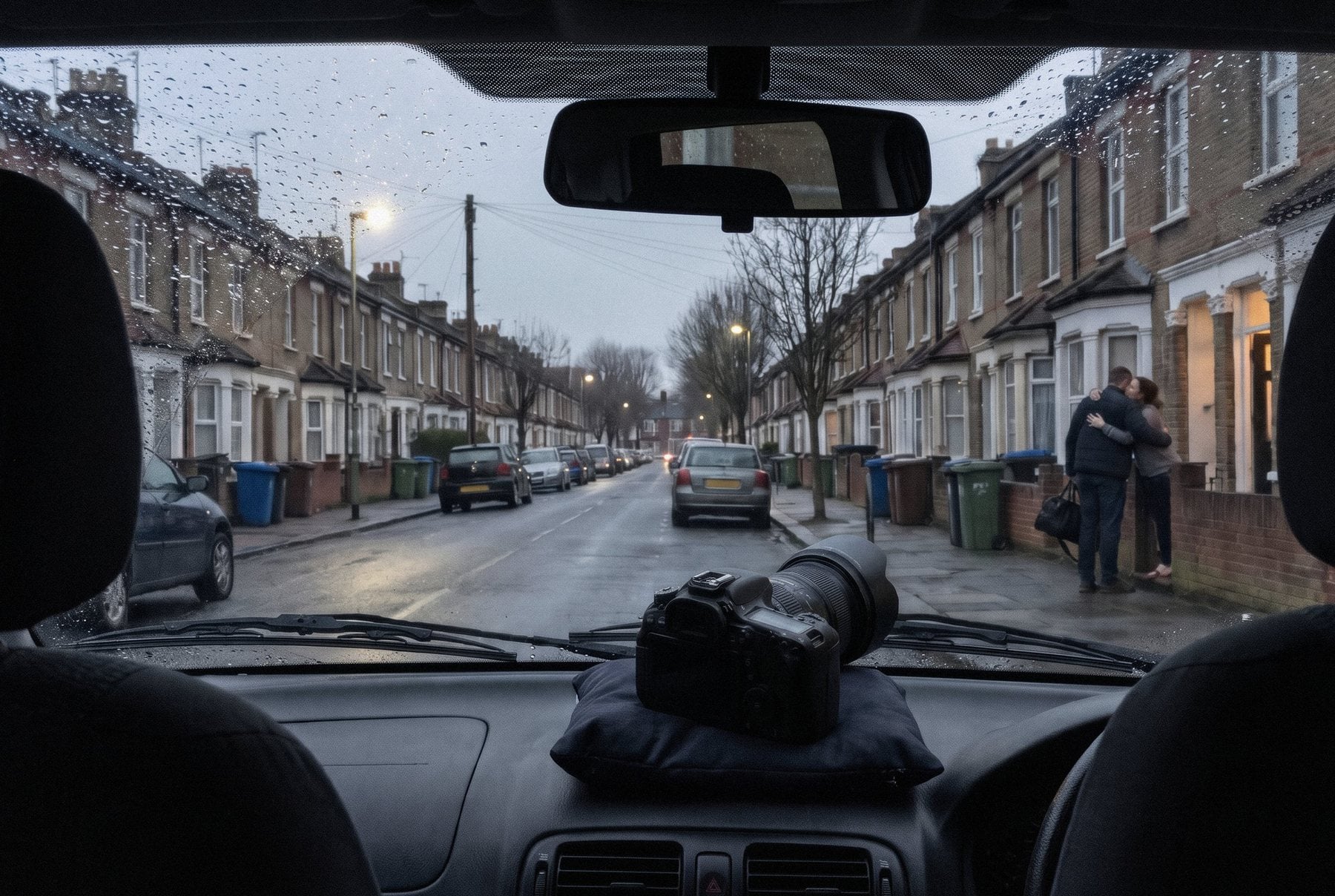
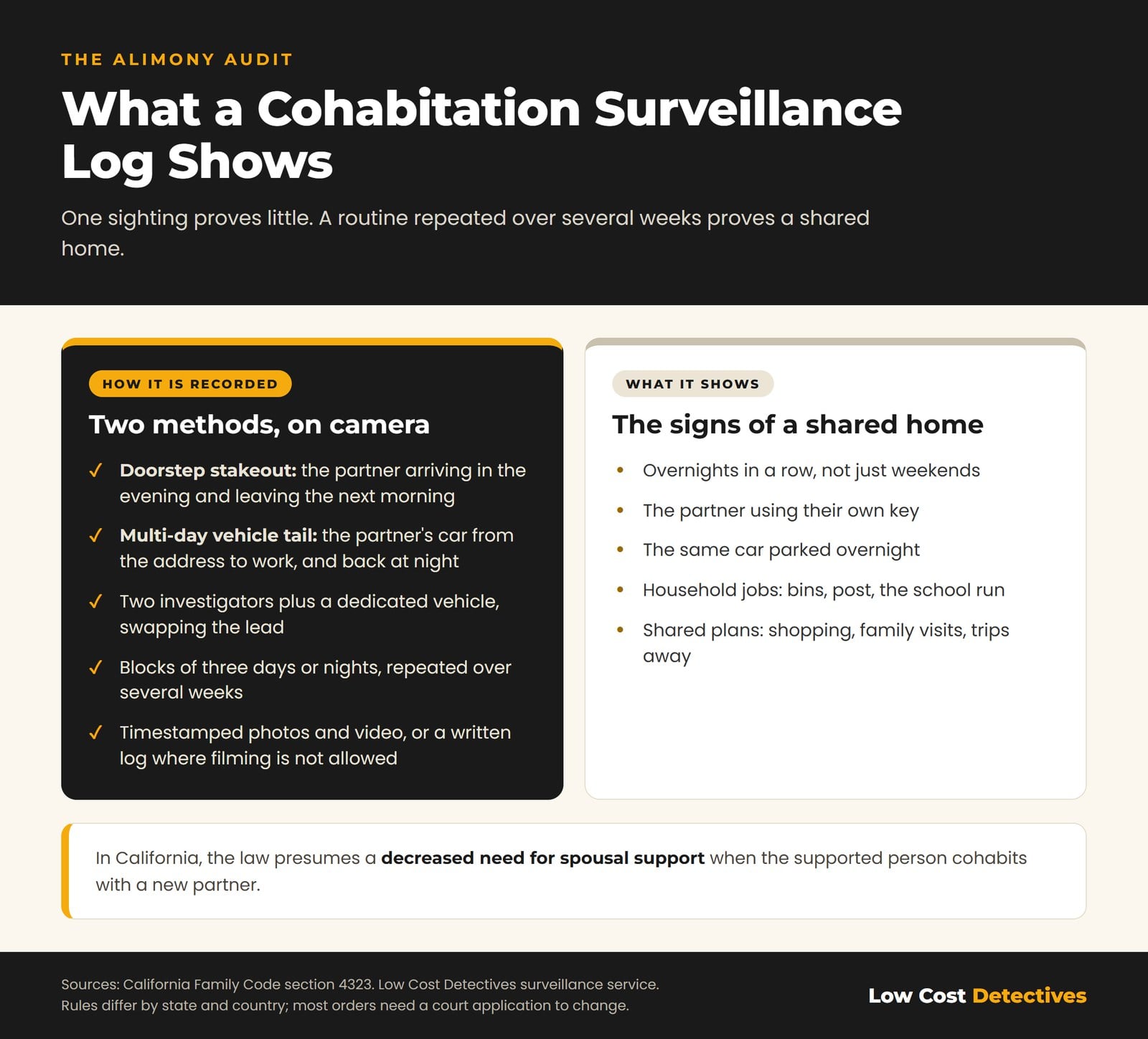
An alimony audit usually combines two methods. The first is the doorstep stakeout. Investigators watch the front door from a discreet position, often a parked car further down the street. They record the partner arriving in the evening and leaving the next morning. A change of clothes overnight is a telling detail.
The second is the multi-day vehicle tail. The team follows the partner’s car when they leave in the morning, and again when they finish work. Do they return to your ex’s address night after night, rather than to a home of their own? That tells the court where they really live. Low Cost Detectives uses a two-person team with a dedicated vehicle. The pair can swap the lead and stay in the background.
Together, these methods put cohabitation on camera. Each clip carries the time, date and place. In countries where filming people is not allowed, our investigators keep a detailed written log instead. Everything then goes into a full evidence report.
The Signs of a Shared Home
- Overnights in a row: the partner stays night after night, not just at weekends.
- Their own key: they let themselves in and lock up when they leave.
- A car parked overnight: the same vehicle sits on the drive from evening until morning.
- Household jobs: putting the bins out, collecting the post, or doing the school run.
- Shared plans: food shopping, family visits, or trips away together.
How Long the Surveillance Takes
A single short burst rarely shows a pattern. Our standard surveillance runs over three days or nights. Cohabitation cases, however, often need more than one block, spread over several weeks. That way, the log shows the same routine again and again. At Low Cost Detectives, your case manager plans the timing, so each block covers the most telling hours.
What You and Your Lawyer Add
Surveillance works best alongside other evidence. Social media often shows holidays, family events or a new shared address. Once a case is underway, your lawyer or solicitor can ask the court to order documents. Tenancy or utility records are common examples. Our cohabitation investigations give that lawyer a clear, dated account to build on. If you are still mid-divorce, a new partner can affect the settlement too. Our divorce investigations cover the wider case.
Cohabitation, Alimony and the Courts
Cohabitation rarely ends alimony on its own. Usually, you ask the court to modify or end the order. The judge then weighs the evidence. Cohabitation and alimony rules also differ from one state or country to the next. So it pays to check what your own order says first.
What Counts as Cohabitation
Most courts look at the whole relationship. Do the two share a home, money and daily life, much like a married couple? In California, the couple do not even need to present themselves as married. Its Family Code section 4323 says holding out as spouses “is not necessary to constitute cohabitation.”
Does Cohabitation End Alimony?
Not automatically, in most cases. In England and Wales, maintenance ends on the receiving spouse’s remarriage, under the Matrimonial Causes Act 1973. Cohabitation is different. It gives you grounds to ask the court to vary the order. The court may then reduce or end the payments. Some orders also name cohabitation as an end point, so check the wording.
Either way, the judge can only act on the evidence, so the quality of the record matters. Our guide to surveillance evidence in UK courts explains how judges weigh footage. For cases heading to court, our matrimonial surveillance service is set up with that in mind.
When It Is a Secret Second Family
Sometimes the question is not about an ex at all. Instead, a partner’s trips, late nights or money no longer add up. You suspect a second household, or a double life. Tracking a secret second family uses the same methods. A cohabitation surveillance private investigator follows your partner to the second address and records the routine there. If you suspect an affair rather than a household, start with surveillance of a cheating partner.
For example, the log might show your partner at the same house every Tuesday. They stay overnight and do the school run. It is painful to learn, but facts help you decide what comes next. The early clues often look like the usual signs of cheating. A second household also costs money. If family funds seem to be disappearing, our hidden assets work can help trace them.
If this is what you are facing, talk to our team in confidence. We can plan surveillance around the days that worry you most, such as regular trips or nights away.
Proof That Holds Up Without Watching Them Yourself
Monitoring an ex yourself rarely works. They know your car and your face, so they soon grow careful. UK harassment law lists “watching or spying on a person” as an act associated with stalking. A cohabitation surveillance private investigator works to a set plan for a set period. That record usually carries more weight with a judge than your own notes.
The result is a calm, dated account of how they really live. Low Cost Detectives works through 300+ branches in 170+ countries, with over 30 years of experience. We also hold a 95% global success rate. When you are ready, speak to our case managers about your situation.
Frequently Asked Questions About Cohabitation Surveillance
Does cohabitation end alimony automatically?
Usually not. In most places, you must ask the court to reduce or end the order. The judge decides on the evidence. Some orders name cohabitation as an end point, so check the wording of yours first. In England and Wales, maintenance ends automatically on remarriage or a new civil partnership, but not on cohabitation.
How do you prove cohabitation after divorce?
You show a pattern of shared life over time. A cohabitation surveillance private investigator records repeated overnights and a partner using their own key. A car parked overnight helps too. Social media and documents your lawyer obtains through the court add to the picture. Together, they show a shared home rather than an occasional visitor.
How long does cohabitation surveillance take?
Our standard surveillance runs over three days or nights. A cohabitation surveillance private investigator often needs more than one block to show a repeated routine. Your case manager plans the timing around the hours that matter most. Late evenings and early mornings usually count.
Can a cohabitation surveillance private investigator find a second family?
Yes. Our team can follow your partner to any regular second address and record what happens there. Over several days, the log can show overnight stays, children, and a shared routine. Low Cost Detectives handles these cases discreetly, and the report sets out times, dates and places clearly.
How much does a cohabitation surveillance private investigator cost?
Surveillance costs £60 per agent per hour. Our surveillance uses a two-person team with a vehicle, usually over three days or nights per block. Before work begins, your case manager confirms the hours, team and any expenses in confidence. That way, you know where you stand from the start.
Is surveillance evidence accepted in court?
UK and US courts usually admit relevant surveillance evidence, then decide how much weight it carries. Dated footage and a clear written log normally count for more than your own notes. How it was gathered matters too. Our investigators record when and where each clip was taken.