Private investigator data privacy laws decide what a detective can collect and keep. They also decide how it is collected. Investigators have no special powers. They work under the same privacy rules as everyone else, plus a few written just for them.
The shadow margin is the space between lawful observation and unlawful intrusion. Most people imagine it as a distance. In law, it is about method, purpose and conduct.
This guide covers the EU and UK, the US, employee monitoring and the line into stalking. Low Cost Detectives does not install tracking apps, and we never access anyone’s phone, messages or accounts.
Key Takeaways
- No special powers: private investigator data privacy laws are mostly ordinary privacy laws, plus some written for investigators.
- EU and UK: GDPR needs a lawful basis, usually legitimate interests, and only the data a case needs.
- US: no single federal privacy law, but strict rules on driver, bank and phone records.
- Employers: covert monitoring needs strong grounds, such as suspected crime or serious misconduct.
- The stalking line: the law looks at conduct and intent, not at how close someone stands.
Private Investigator Data Privacy Laws in the EU and UK: GDPR at Work
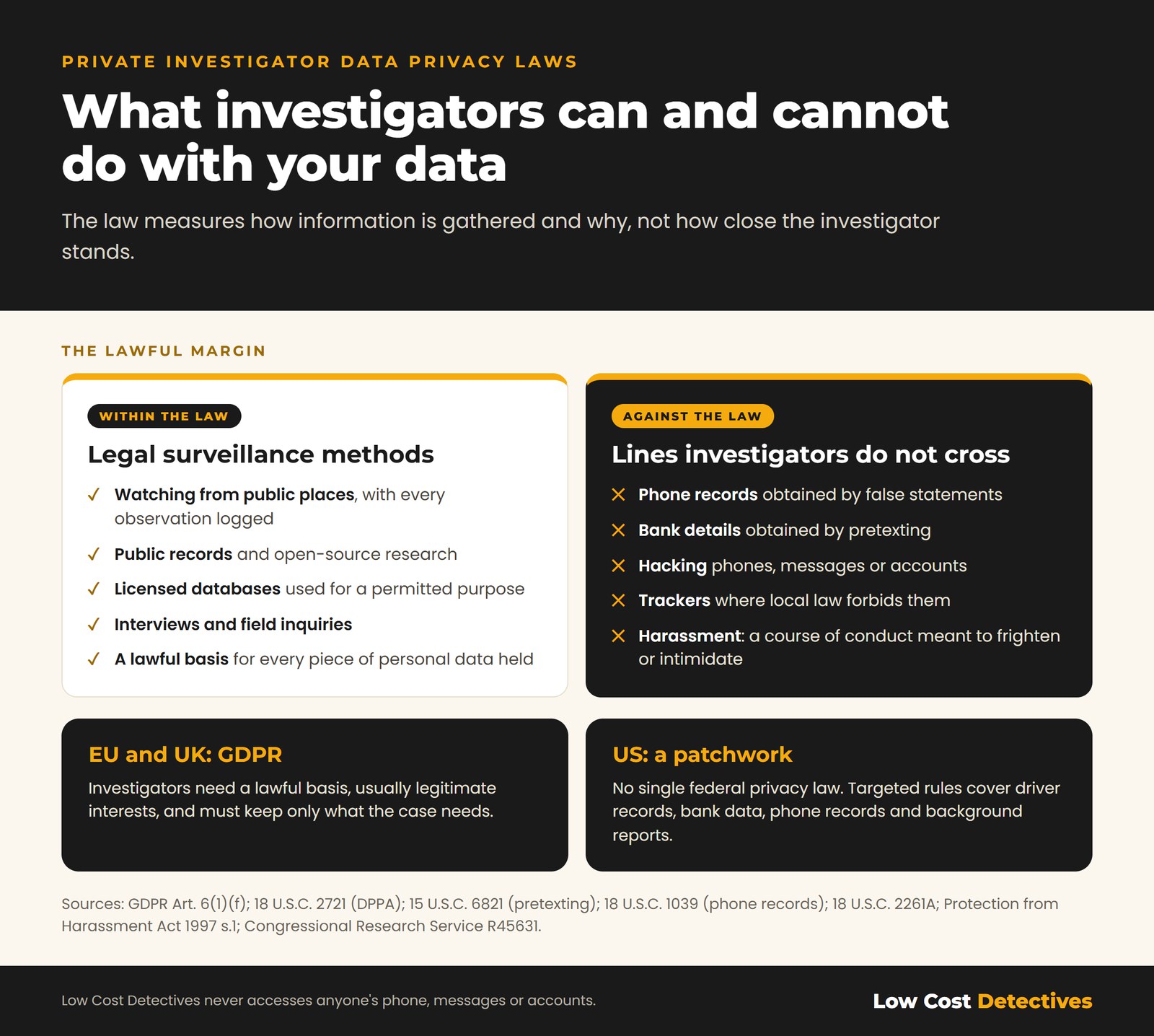
Private investigator data privacy laws in Europe start with GDPR. It applies to investigators like any other business. Watching, photographing or researching an identifiable person is processing personal data. So is storing a report about them.
Every investigation needs a lawful basis. For investigators, that is usually legitimate interests under Article 6(1)(f). They must not be overridden by the subject’s rights, “in particular where the data subject is a child.” Data minimization means keeping only what the case needs. Retention should end when the case does.
What the UK Adds
The UK has two extra pieces. The Data Protection Act 2018 allows disclosure where it is needed for legal proceedings. In November 2024, the ICO also approved a UK GDPR code of conduct for investigators. It covers the lawful basis for covert surveillance and tracking devices. It also covers impact assessments.
Belgium’s Stricter Model
Some countries go further. Belgium’s Private Investigation Act came into force in December 2024. Investigators need prior authorization from the Ministry of the Interior. Investigating an employee has an extra step. The employer must set out the authorization and process in writing, such as an internal policy.
The US Patchwork: Driver Records, Pretexting and Background Reports
The US has no GDPR. The Congressional Research Service has noted that no single federal law comprehensively regulates consumers’ personal data. Instead, private investigator data privacy laws in the US are a set of targeted rules.
Driver Records
The Driver’s Privacy Protection Act bars state DMVs from disclosing personal information from motor vehicle records. It allows use “by any licensed private investigative agency”, but only for a permissible use. That exception is narrow, and every request needs one.
Pretexting and Phone Records
Pretexting means getting information by pretending to be someone else, or by lying about why you want it. Federal law makes it a violation to obtain a bank’s customer information through false statements. Getting confidential phone records by false statements is a separate federal crime. It carries up to 10 years in prison. At Low Cost Detectives, we use neither.
Background Reports
Background checks bring in the Fair Credit Reporting Act. It governs consumer reports, including those used for employment decisions. There is a carve-out for employers. Reports on suspected workplace misconduct can fall outside the “consumer report” definition, if strict conditions are met. Our background check investigations work within these rules.
Employee Monitoring Law: When Employers Bring In an Investigator
Employers are among investigators’ biggest clients, so employee monitoring law matters. It is where private investigator data privacy laws meet employment law. The rules differ sharply between the US and Europe.
In the US
The Electronic Communications Privacy Act includes the federal wiretap rules. They generally allow recording a conversation when one party consents. Its Stored Communications Act also limits access to stored emails and messages. Some states add notice rules. New York requires employers that monitor phone, email or internet use to give “prior written notice upon hiring”. Employees must acknowledge it, and the notice must be posted.
In practice, employers are safest monitoring company-owned devices for a legitimate business purpose. That should sit in a monitoring policy in the employee handbook. Personal devices and GPS tracking outside working hours carry far more risk.
In the UK and EU
The ICO says it is unlikely covert monitoring can be justified “in most usual circumstances”. The exception is suspected criminal activity or gross misconduct. Senior management must authorize it, and a data protection impact assessment is required.
The European Court of Human Rights tested this in Lopez Ribalda v Spain in 2019. A supermarket used hidden cameras on cashiers it suspected of theft. The Grand Chamber found no violation of the right to privacy, by 14 votes to 3. It held that “reasonable suspicion that serious misconduct has been committed” could be weighty justification. It also said the slightest suspicion would not be enough.
For employers, the lesson is the same everywhere. Have a written policy, a real suspicion and a proportionate plan before anyone watches staff. Our employee theft investigations start from that footing. For business partners rather than staff, due diligence is usually the better first step.
Legal Surveillance Methods and the Line Into Stalking
Private investigator data privacy laws shape every method below. They also explain why some methods are off the table.
How Do Detectives Monitor Someone?
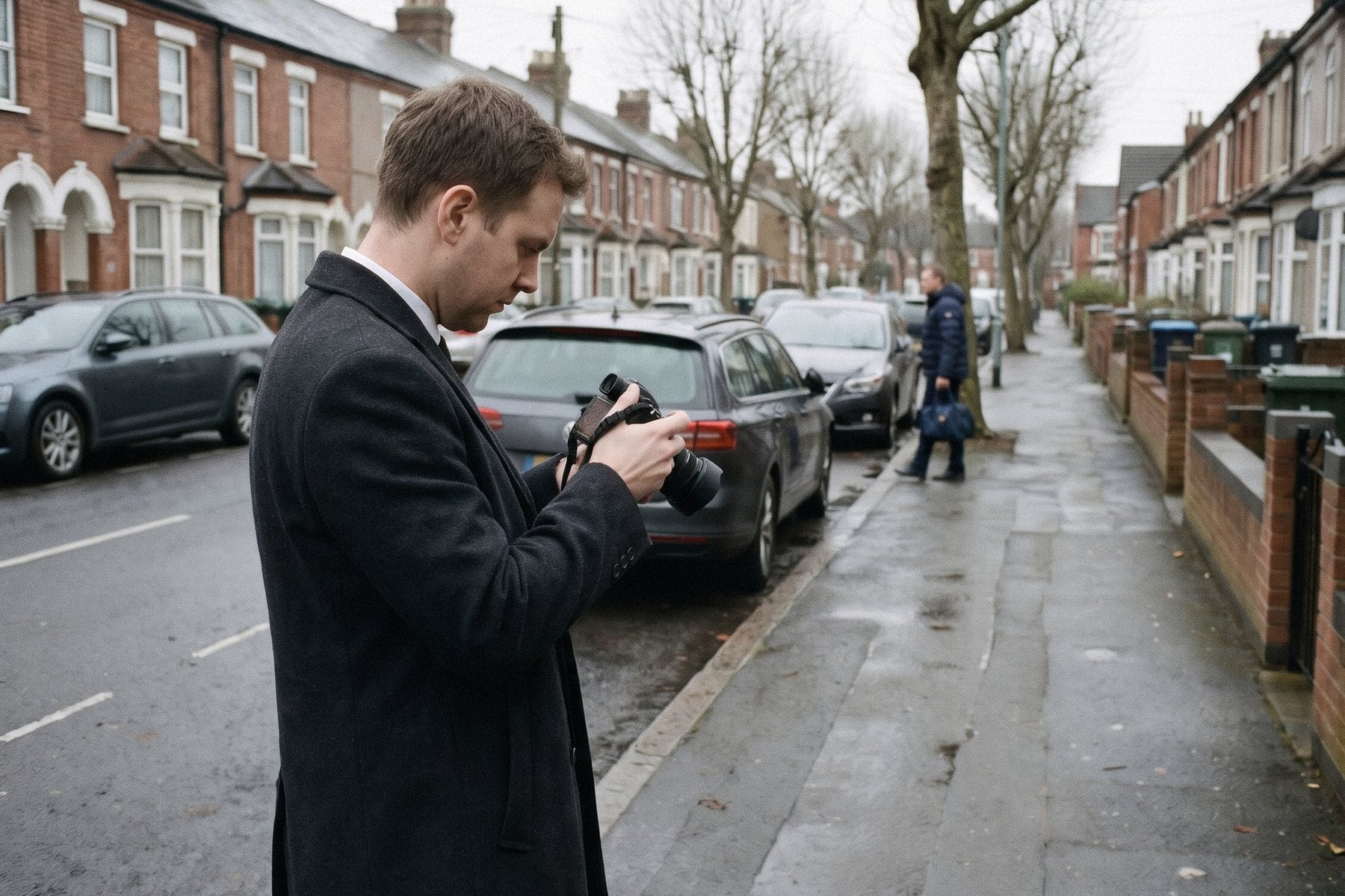
Legal surveillance methods are less dramatic than films suggest. Investigators watch from public places and log what they see. They search public records and open sources, such as public social media posts. They use licensed databases for permitted purposes, and they make field inquiries.
At Low Cost Detectives, our surveillance private investigator teams work in pairs from public places. Our people tracing service relies on records, databases and local agents.
Conduct, Not Distance
No US or UK law sets a distance an investigator must keep. Stalking and harassment laws look at what someone does, and why.
Harassment law in England and Wales targets a course of conduct. The person must know, or ought to know, that it amounts to harassment. One defense applies where the conduct was “for the purpose of preventing or detecting crime.” Another applies where it was reasonable in the circumstances, under the Protection from Harassment Act.
US federal stalking law turns on intent. It requires acting “with the intent to kill, injure, harass, intimidate”, or surveillance with that intent. It also needs a course of conduct causing fear or substantial emotional distress. A lawful investigation has a different purpose: gathering facts for a client or a court.
So the shadow margin is not measured in meters. It is measured in purpose, method and restraint. An investigator who follows lawfully, avoids contact and stops when the job ends is within it.
If you think someone is monitoring you unlawfully, bug sweeping can check your home, car or office. If you are unsure whether a method is lawful, speak to our investigators before anything starts.
Choose an Investigator Who Knows Where the Margin Is
Private investigator data privacy laws protect the people being investigated. They also protect clients, because unlawfully gathered evidence can damage a case. Ask any investigator about compliance: how they will gather information, what they will keep and for how long.
Low Cost Detectives works through 300+ branches in 170+ countries, under each country’s privacy rules. For cases heading to court, our legal and litigation support team works with your lawyers. Talk to our team in confidence about your case.
Frequently Asked Questions About Private Investigator Data Privacy Laws
How do detectives monitor someone legally?
They watch from public places and log what they see, with photos or video where the law allows. They also research public records, open sources and licensed databases for a permitted purpose. Lawful investigators do not hack phones or read private messages. They do not obtain phone or bank records by deception or fit trackers where the law forbids it.
Does GDPR apply to private investigators?
Yes. In the EU and UK, watching, photographing or researching an identifiable person is processing personal data. They need a lawful basis, usually legitimate interests, and must keep only what the case needs. In the UK, the ICO approved a GDPR code of conduct for investigators in November 2024.
Can a private investigator get someone’s DMV, bank or phone records?
Not by deception. US federal law bans obtaining bank customer information or confidential phone records through false statements. DMV records are protected too, though licensed investigators may use them for a purpose the law permits. Low Cost Detectives never accesses anyone’s phone, messages or accounts.
Can an employer monitor staff without telling them?
It depends on where you work. In the UK, the ICO says covert monitoring is rarely justified, except for suspected crime or gross misconduct. New York requires written notice of electronic monitoring when employees are hired. The European Court of Human Rights accepted covert filming in one case of suspected theft by cashiers.
When does surveillance become stalking?
When the conduct and purpose change, not the distance. Stalking and harassment laws target a course of conduct that harasses, frightens or intimidates someone. A lawful investigation gathers facts for a client or court, from public places, without contact. Repeated, intimidating behavior crosses the line, however far away the watcher stands.