
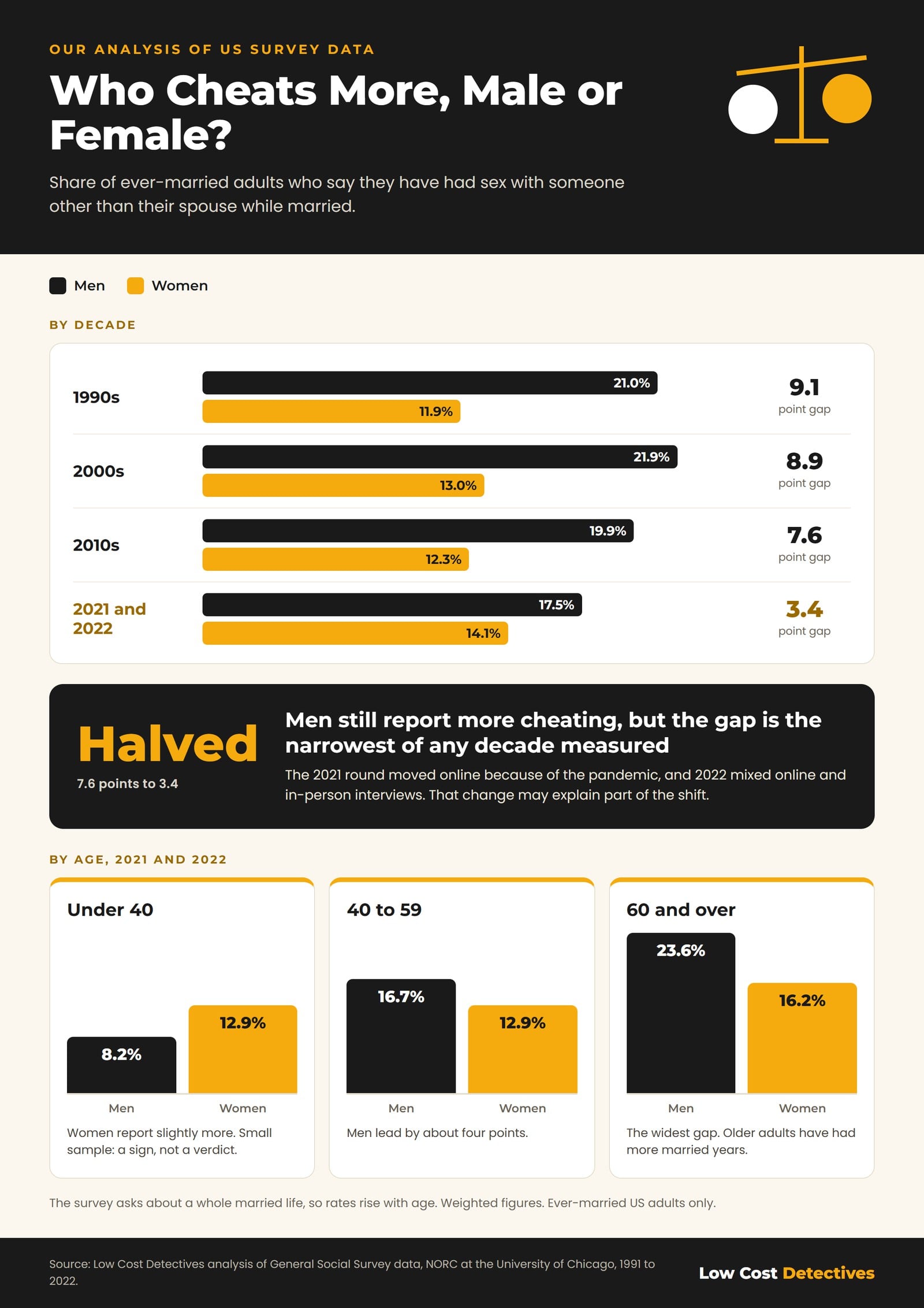
Who cheats more, male or female? Men still do, but by far less than most people think. In our analysis of the latest General Social Survey data, 17.5% of ever-married men said they had cheated. So had 14.1% of ever-married women.
Most articles on who cheats more, male or female, still quote figures from 2018. Those figures rest on survey data from about 2010 to 2016. Back then, the gap was close to seven points. It has since roughly halved.
At Low Cost Detectives, our investigators have over 30 years of experience in 170+ countries. Below, we break down the numbers by age, motive, and type of affair. We also explain what they can and cannot tell you about your own partner.
Key Takeaways
- Men still report more cheating than women: 17.5% against 14.1% in 2021 and 2022.
- The gap has roughly halved since the 2010s, when it stood at almost eight points.
- Among married adults under 40, women now report slightly more cheating than men.
- The answer to who cheats more, male or female, also depends on how you define cheating.
Who Cheats More, Male or Female? The Short Answer
The General Social Survey has asked Americans about extramarital sex in every round from 1991 to 2022. It asks people who have ever married one thing. Have they had sex with someone other than their spouse while married?
Low Cost Detectives analyzed every round, up to 2022, the last year the question was asked. The pattern is plain. Men have always reported more cheating, but the gap is shrinking.
| Survey years | Men | Women | Gap |
|---|---|---|---|
| 1990s | 21.0% | 11.9% | 9.1 points |
| 2000s | 21.9% | 13.0% | 8.9 points |
| 2010s | 19.9% | 12.3% | 7.6 points |
| 2021 and 2022 | 17.5% | 14.1% | 3.4 points |
Share of ever-married US adults who say they have cheated while married, weighted. Source: Low Cost Detectives analysis of General Social Survey data.
The older figures match other research. In 2018, the Institute for Family Studies reported that 20% of men and 13% of women had cheated. Its research director, Wendy Wang, wrote that “men have always been more likely than women to cheat.”
A stricter 2019 survey counted only physical affairs kept secret from a spouse. It found the same lead, with 20% of men and 10% of women.
How we checked the numbers. We used the cumulative survey file from NORC at the University of Chicago. We counted adults who have ever married and applied the survey’s own weights. Our figures for 2010 to 2016 match the 2018 research almost exactly. Like all research on spousal infidelity, the survey relies on what people admit. One caution applies. The 2021 round moved online because of the pandemic, and 2022 mixed online and in-person interviews. That change may explain part of the shift.
How Age Changes the Answer
Age matters as much as sex. The survey asks about a whole married life, so older people have had more time to stray. In 2021 and 2022, the figures looked like this:
- Under 40: 12.9% of women and 8.2% of men said they had cheated.
- Ages 40 to 59: 16.7% of men and 12.9% of women.
- Age 60 and over: 23.6% of men and 16.2% of women.
So who cheats more, male or female, among younger couples? On these figures, women do. The 2018 research found the same at ages 18 to 29: 11% of women against 10% of men. The younger samples are small, so treat this as a sign rather than a verdict.
The widest gap sits with older adults. In the 2018 research, men in their 70s had the highest rate of any group, at 26%. Women peaked in their 60s, at 16%.
The researchers pointed to a generation effect. Americans born in the 1940s and 1950s came of age during the sexual revolution. As younger generations make up more of the married population, the overall gap may keep narrowing.
Sex and age are not the only factors. The 2018 research also linked cheating to family background and religious practice.
Why Men and Women Cheat, and the Affairs Surveys Miss
Motives differ more than rates do. A 2015 YouGov survey asked Americans who had cheated why. Men were more likely to blame their sex life. In all, 44% of men gave that reason, against 27% of women. Women were more likely to say they felt emotionally deprived, at 47% against 38% of men. Both are forms of relationship dissatisfaction, but they are not the same.
Older British polling points the same way. In a 2010 YouGov poll, women who cheated were far more likely to blame marital unhappiness. The figures were 58% against 35% of men. Thrill-seeking ran the other way: 21% of men cited it, and only 4% of women. For more on motives, read about why people cheat and what follows.
Emotional affairs change the count
Most surveys, including the GSS, ask about sex. That misses affairs that never become physical, though most people still see them as betrayal. In a national survey on what counts as cheating, 76% said a secret emotional relationship counts.
In that survey, 7% of ever-married people had an emotional-only affair, 5% a sexual one, and 10% both. Women made up 56% of emotional-only affairs. Men made up 75% of sexual-only affairs and 56% of combined affairs. The researcher, Jeffrey Dew, concluded that “neither sexual desire nor sexual contact are prerequisites for infidelity.”
So the answer to who cheats more, male or female, depends on the definition. Count only sex, and men lead. Count emotional affairs too, and the gap shrinks further.
Does someone who cheated once cheat again?
Among the risk factors researchers study, past behavior stands out. A study of serial infidelity followed 484 adults through two relationships. Those who cheated in the first were three times more likely to cheat in the next.
The finding held for men and women alike. The authors concluded that “prior infidelity emerged as an important risk factor for infidelity in next relationships.” Suspicion repeats too. People who suspected a partner once were four times more likely to suspect the next one. A higher risk is not a certainty, though. It describes a pattern across many people, not a rule for one.
What the Numbers Mean If You Suspect Your Partner
Many people asking these questions are not just curious. They worry about an unfaithful spouse or partner. Statistics describe groups, not people. Knowing who cheats more, male or female, tells you little about your own partner. Their sex and age prove nothing either way.
What the data does show is that cheating and relationship breakdown often go together. In 2021 and 2022, 40% of people who had cheated were divorced or separated. Among those who had not cheated, the figure was 17%.

If you suspect a cheating partner, start with what you can see. Note new routines, unexplained absences, or a phone that is never left alone. Suspicion alone can create trust issues, so look for facts. Our free suspicious behavior check helps you sort worry from warning signs.
Do not go through their phone, email, or accounts without permission. In many places it can break the law, and it can harm any later case.
How an infidelity investigation works
When you need facts rather than odds, an infidelity investigation can help. At Low Cost Detectives, it usually takes one of two forms.
- Surveillance. A two-person team records where your partner goes and who they meet. Our surveillance reports include timestamped photos and video where local law allows. Some countries allow written observation only.
- Loyalty test. A trained agent makes natural contact with your partner. In a loyalty test, the agent responds to their conduct and records it, but never leads it.
Either way, you receive a written report of what was seen. We never access phones, messages, or online accounts.
You do not have to face this alone. Speak to one of our investigators today, in complete confidence.
Men Still Lead, but the Gap Is Narrowing
Who cheats more, male or female? Across three decades of survey data, men do. But their lead has roughly halved, and younger women now report slightly more than younger men.
If the numbers have raised a question about your own relationship, you do not need to guess. Low Cost Detectives works discreetly in 170+ countries, with a 95% global success rate. We understand how difficult this situation is. Contact us in confidence, and we will help you find the truth.
Frequently Asked Questions: Who Cheats More, Male or Female?
Who cheats more, men or women?
Men do, in the major US surveys. In General Social Survey data from 2021 and 2022, 17.5% of ever-married men said they had cheated. So did 14.1% of ever-married women. The gap has roughly halved since the 2010s, so it is far smaller than most people assume.
Do women cheat more than men now?
Not overall. But the answer to who cheats more, male or female, flips in some age groups. In 2021 and 2022, married women under 40 reported more cheating than men their age. The figures were 12.9% against 8.2%. Research from 2018 found the same pattern at ages 18 to 29. Men still lead overall, especially after age 60.
At what age are people most likely to cheat?
Reported cheating rises with age, partly because older people have been married for longer. In 2021 and 2022, men aged 60 and over had the highest rate, at 23.6%. In research from 2018, women peaked in their 60s at 16%. Men peaked in their 70s, at 26%.
Is an emotional affair cheating?
Most people think so. In a national survey, 76% said a secret emotional relationship in real life is infidelity. For an online one, the figure was 72%. Women in that survey reported more emotional-only affairs than men. That is one reason surveys that ask only about sex may undercount women.
Will someone who cheated once cheat again?
They are more likely to, though it is not certain. One study followed 484 adults through two relationships. People who cheated in the first were three times more likely to cheat in the next. The pattern held for both men and women. A past affair is a risk factor, not a prediction.
Why do men and women cheat?
Their reasons tend to differ. In a 2015 YouGov survey, 44% of men who cheated blamed sexual dissatisfaction, against 27% of women. Women were more likely to say they felt emotionally deprived, at 47% against 38%. Older British polling also found men far more likely to cite the thrill.
What does an infidelity investigation involve?
At Low Cost Detectives, it usually means surveillance or a loyalty test. Surveillance documents where a partner goes and who they meet. A loyalty test records how they respond to a natural approach. Either way, you receive a confidential written report. We never access a partner’s phone, messages, or online accounts.