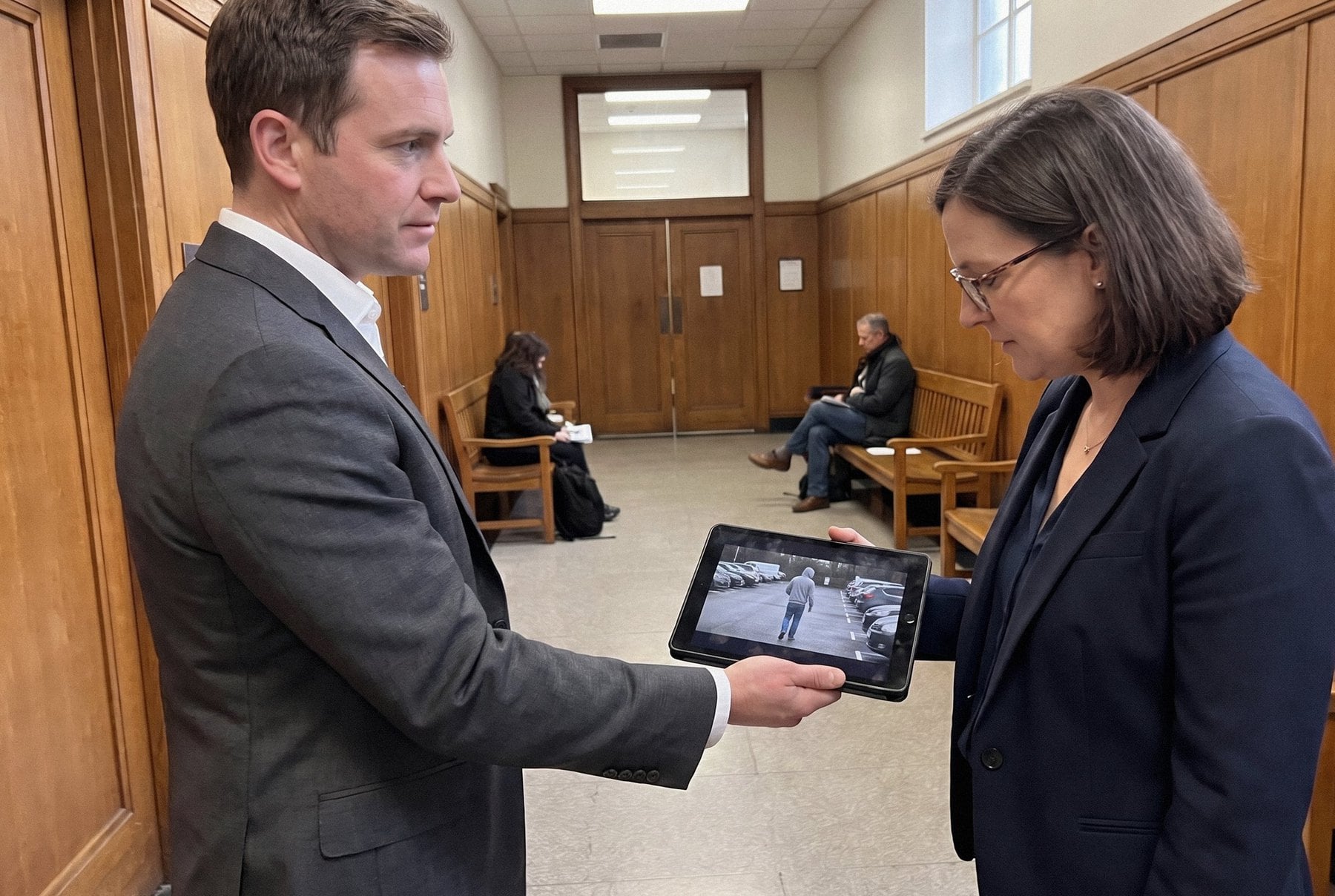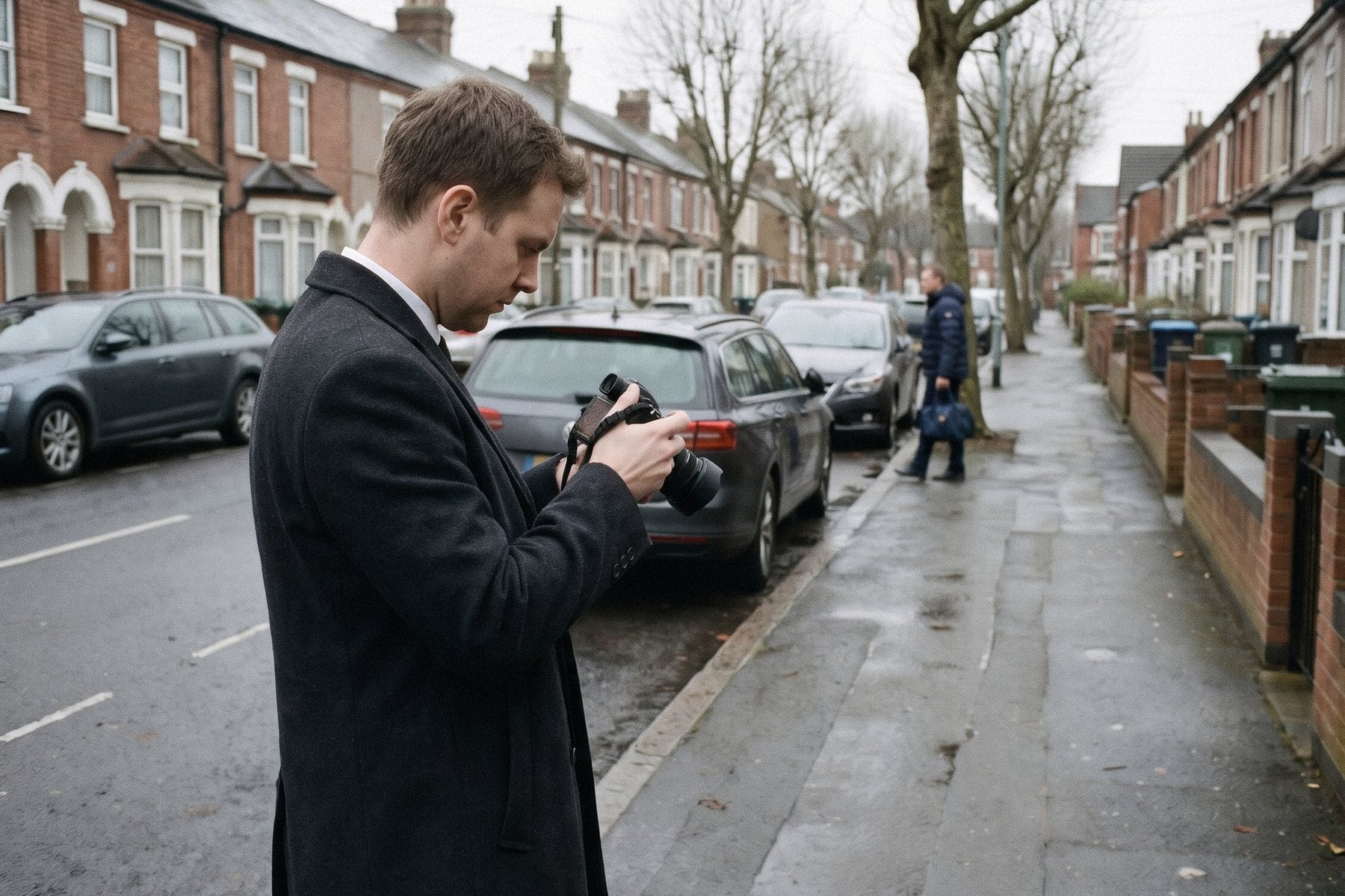

UK surveillance court admissibility depends less on what footage shows than on how someone gathered it. A clip of a parent, a claimant, or an employee can decide a case. It can also start an argument that costs more than the case is worth.
The Family Justice Council’s May 2025 guidance is clear on one point. There is “no automatic bar” to evidence that someone obtained improperly. Still, the court weighs how someone made the footage, and whether the method was lawful.
This guide covers how each court in England and Wales treats surveillance footage. It also covers UK GDPR for investigators, and long-lens video that holds up in family court. At Low Cost Detectives, we plan our UK surveillance work around these rules from day one.
Key Takeaways
- No automatic bar: UK courts can admit improperly obtained footage, but they weigh how someone made it.
- Family court is different: the child’s welfare comes first, and covertly recording children rarely helps a case.
- GDPR applies: the household exemption is unlikely to cover footage gathered for court.
- Someone else’s car is off limits: a tracker on another person’s vehicle can amount to stalking.
- Records win cases: logged observations, original files and early disclosure support UK surveillance court admissibility.
UK Surveillance Court Admissibility: How Each Court Treats Footage
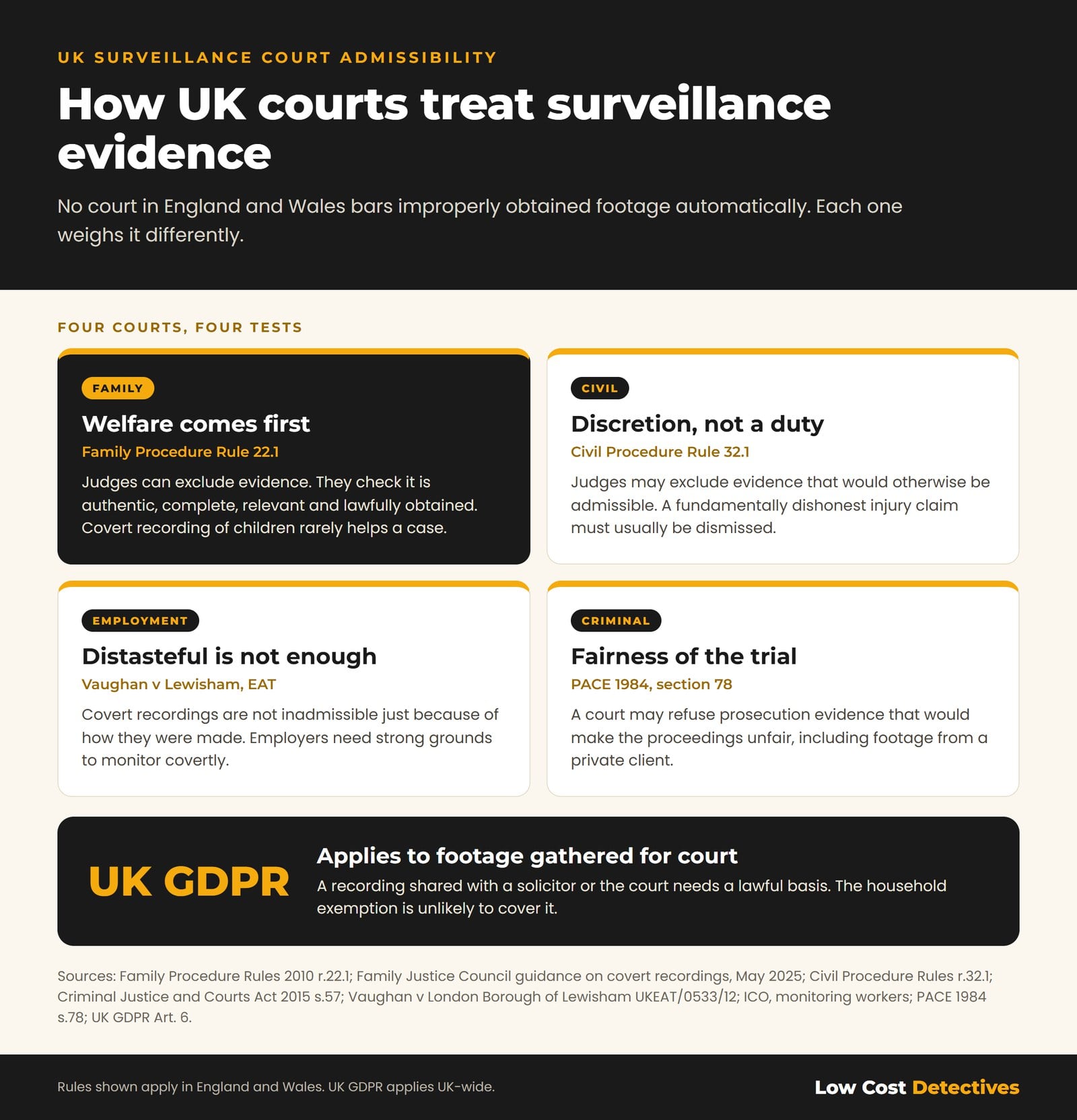
UK surveillance laws on evidence differ from court to court, but every court starts from the same point. Courts usually admit relevant footage. Judges then decide how much weight it carries, and whether the method changes that. The rules below apply in England and Wales.
Civil Claims and Personal Injury
Judges in civil cases have a discretion, not a duty, to exclude evidence. Civil Procedure Rule 32.1 lets them exclude evidence that would otherwise be admissible. In practice, insurers often use surveillance to test what a personal injury claimant says they can do.
Section 57 of the Criminal Justice and Courts Act 2015 is strict. If a claimant has been “fundamentally dishonest”, the court must dismiss the claim. The only exception is where dismissal would cause the claimant substantial injustice. Our US and UK admissibility guide covers the leading civil case on covert filming.
Family Court
Surveillance can matter in divorce investigations, financial settlements and child arrangements. Family judges, similarly, have the same power to exclude evidence under Family Procedure Rule 22.1. The Family Justice Council’s guidance says courts look at several things. Is the recording authentic and complete? Is it relevant, with real probative value? Was it lawfully obtained?
Financial cases also follow the same line. In Imerman v Tchenguiz, the Court of Appeal said the court “can admit such evidence”. It also has power to exclude unlawfully obtained evidence. Surveillance often matters when one party says they live alone but shares a home with a new partner. Our cohabitation investigations focus on exactly that question.
In child arrangements cases, UK surveillance court admissibility starts with the child’s welfare. The guidance warns that “the covert recording of children rarely promotes a child’s welfare whatever the intention.” Surveillance usually focuses on an adult’s conduct instead, such as missed handovers or drinking before contact. See how our child custody investigations work. Low Cost Detectives handles surveillance for divorce, financial and child arrangements cases.
Employment Tribunals
Employment tribunals take a practical view of UK surveillance court admissibility. In Vaughan v London Borough of Lewisham, the Employment Appeal Tribunal called covert recording “very distasteful”. Even so, it ruled that how someone took such recordings does not make them inadmissible.
Employers building a disciplinary case, however, face their own rules. The ICO says employers are unlikely to justify covert monitoring “in most usual circumstances”. The exception covers suspected criminal activity or gross misconduct. Even then, senior management must authorize it. The employer must also carry out a data protection impact assessment.
Criminal Courts
In criminal cases, section 78 of the Police and Criminal Evidence Act 1984 applies. A court may refuse prosecution evidence if admitting it would harm the fairness of the proceedings. That also includes footage a private client hands to the police.
GDPR in the Field: What the Law Asks of Investigators
Footage of an identifiable person is personal data under UK GDPR. Filming, storing and sharing it all count as processing. The Information Commissioner’s Office regulates that processing across the whole of the UK.
Data protection is part of UK surveillance court admissibility. A breach does not exclude footage by itself, but it can count against it.
Why the Household Exemption Is Unlikely to Cover Court Evidence
Purely personal or household use falls outside UK GDPR, such as photos taken for your own enjoyment. Many people assume that covers footage filmed at home. The Family Justice Council calls that view “a misapprehension”. Once you share a recording with a solicitor or the court, it needs a lawful basis.
Private Investigator GDPR Compliance
Private investigator GDPR compliance starts with the lawful basis. For covert surveillance, that is usually legitimate interests under Article 6(1)(f). The subject’s rights can outweigh them, “in particular where the data subject is a child.” Good practice keeps surveillance proportionate, with data minimization, secure retention and a data protection impact assessment.
Two more rules apply. Businesses that use personal data must pay the ICO’s data protection fee unless exempt. The Data Protection Act 2018 also allows disclosure where legal proceedings need it. In November 2024, the ICO approved a UK GDPR code of conduct for the investigation sector. The Association of British Investigators code covers covert surveillance and tracking devices.
RIPA and Licensing
Two common beliefs are wrong. The Regulation of Investigatory Powers Act 2000 does not govern private clients. The Family Justice Council notes RIPA “only applies to the actions of the State”. There is also no licensing scheme for UK private investigators. In 2022, the Security Industry Authority said it had “no plans at this time” to regulate private investigations.
Long-Lens Video Evidence That Survives Family Court
The footage that holds up best is plain: an adult, in public, logged and unedited.
Filming From Public Places
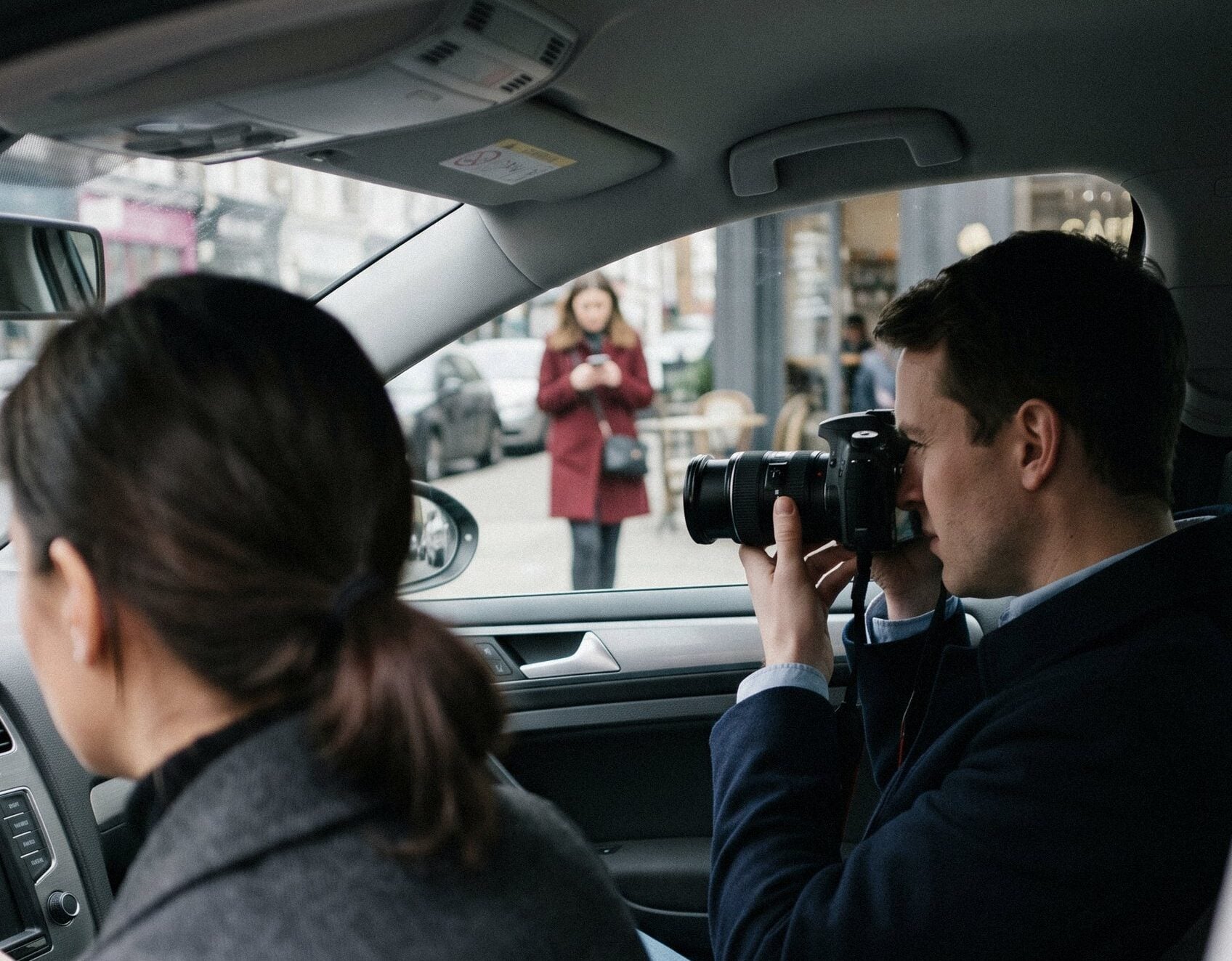
There is no general ban on filming people in public in the UK. A long lens lets an investigator record from a lawful spot without approaching anyone. At Low Cost Detectives, our surveillance team in the UK works in pairs with a vehicle. The subject is never engaged or alerted, so the footage shows ordinary behavior.
When Children Are in Frame
Filming in public does not end the right to privacy under Article 8 of the Human Rights Act. Murray v Big Pictures shows why. A photo agency covertly photographed a young child on a public street. Even so, the Court of Appeal held he had an arguable expectation of privacy. That is why careful investigators keep children out of focus and record the adult’s conduct instead. The ICO has also indicated that covertly recording children is likely to breach their privacy.
Logs, Originals and Disclosure
Good records are the backbone of UK surveillance court admissibility. First, keep the original files unedited, with a clear record of who has handled them. Then disclose the evidence under the court’s directions, not as a surprise at the hearing.
One line is absolute. Recording a court hearing without permission is a contempt of court, including remote hearings.
At Low Cost Detectives, our investigators log every observation with the time, date and place. You then receive a written evidence report, with photos or video where the law allows. If you need footage for a family case, speak to our investigators before anyone starts filming.
Is Vehicle Tracking Legal in the UK?
It depends on whose vehicle it is. Tracking a car you own, for your own personal use, raises few issues. Tracking a car someone else uses, however, is different. Their location data is personal data, and a tracker fitted without consent can amount to stalking.
The Protection from Harassment Act 1997 lists acts linked to stalking. One is “interfering with any property in the possession of a person.” Another is “watching or spying on a person.” In 2025, the Crown Prosecution Service reported one such case. A man pleaded guilty to stalking after putting a tracking device on the victims’ car. He said he thought the car belonged to someone he suspected of an affair with his partner.
Company vehicles, by contrast, follow employment rules. Employers can monitor work vehicles if they have a clear purpose and tell staff. Covert tracking falls under the ICO’s strict rules on covert monitoring above.
Plan the Evidence Before the First Hearing
UK surveillance court admissibility starts long before anyone stands up in court. It turns on where the camera was, who was in frame, and how someone kept the files.
Low Cost Detectives has its headquarters in London and works across 170+ countries through 300+ branches. Our surveillance private investigator service covers the UK and abroad. For cases already with a solicitor, our legal and litigation support team can help. Talk to our team in confidence about the evidence your case needs.
Frequently Asked Questions About UK Surveillance Court Admissibility
Is surveillance evidence admissible in a UK family court?
It usually can be. UK surveillance court admissibility in family cases turns on relevance, authenticity and welfare. Family Procedure Rule 22.1 lets the judge exclude evidence, but improperly obtained evidence is not automatically barred. Footage of an adult’s conduct in public is easier to rely on than covert recordings of children.
Is vehicle tracking legal in the UK?
Tracking your own car is generally fine. But putting a GPS tracker on a car someone else uses is risky. Stalking law covers “watching or spying on a person.” In 2025, the CPS reported a stalking guilty plea after a man fitted a tracker to a car. Employers need a clear purpose for tracking work vehicles and must tell staff.
Do private investigators need to comply with UK GDPR?
Yes. Footage of an identifiable person is personal data, so investigators need a lawful basis, usually legitimate interests. They should record only what the case needs, store it securely and assess the risks of covert work. Businesses using personal data must pay the ICO fee unless exempt. In 2024, the ICO approved a code of conduct for the sector.
Can a parent record an ex-partner or their children for a family case?
Be careful. Recording for a court case is unlikely to fall under the household exemption, so UK GDPR can apply. The Family Justice Council warns that covertly recording children rarely helps their welfare. The court may also judge your conduct in making the recording. Recording a court hearing without permission is always a contempt of court.
Do UK private investigators need a license?
No. The government never brought in Security Industry Authority licensing for private investigators. In 2022, the authority said it had no plans to regulate private investigations. Investigators must still follow UK GDPR, harassment law and the rules on interception. Choose one who can explain their lawful basis and how they keep records.