Court admissible surveillance evidence is footage a judge allows into a case and weighs alongside the other evidence. Getting there depends less on the camera than on how the recording was made.
In the US, a hidden camera that picks up other people’s conversations can break the federal Wiretap Act. Recordings made that way cannot be used as evidence at all. In the UK, the Court of Appeal allowed hidden camera footage filmed inside a claimant’s home. It still made the defendants pay the costs of the fight over it.
This guide sets out the checklist for court admissible surveillance evidence, and the US and UK rules. At Low Cost Detectives, we build every surveillance report around those rules.
Key Takeaways
- Lawful comes first: footage filmed in public, with no unlawful audio, has the best chance of being admitted.
- Audio is the US weak point: federal law needs one party’s consent, and California needs every party’s.
- UK judges have discretion: they can admit improperly obtained footage, but whoever gathered it can still pay.
- UK GDPR applies once a home camera records beyond your property boundary, and that includes voices.
- Our surveillance team logs every observation with the time, date, and place, which helps authenticate the footage.
The Admissibility Checklist: What Courts Look For Before Footage Is Shown
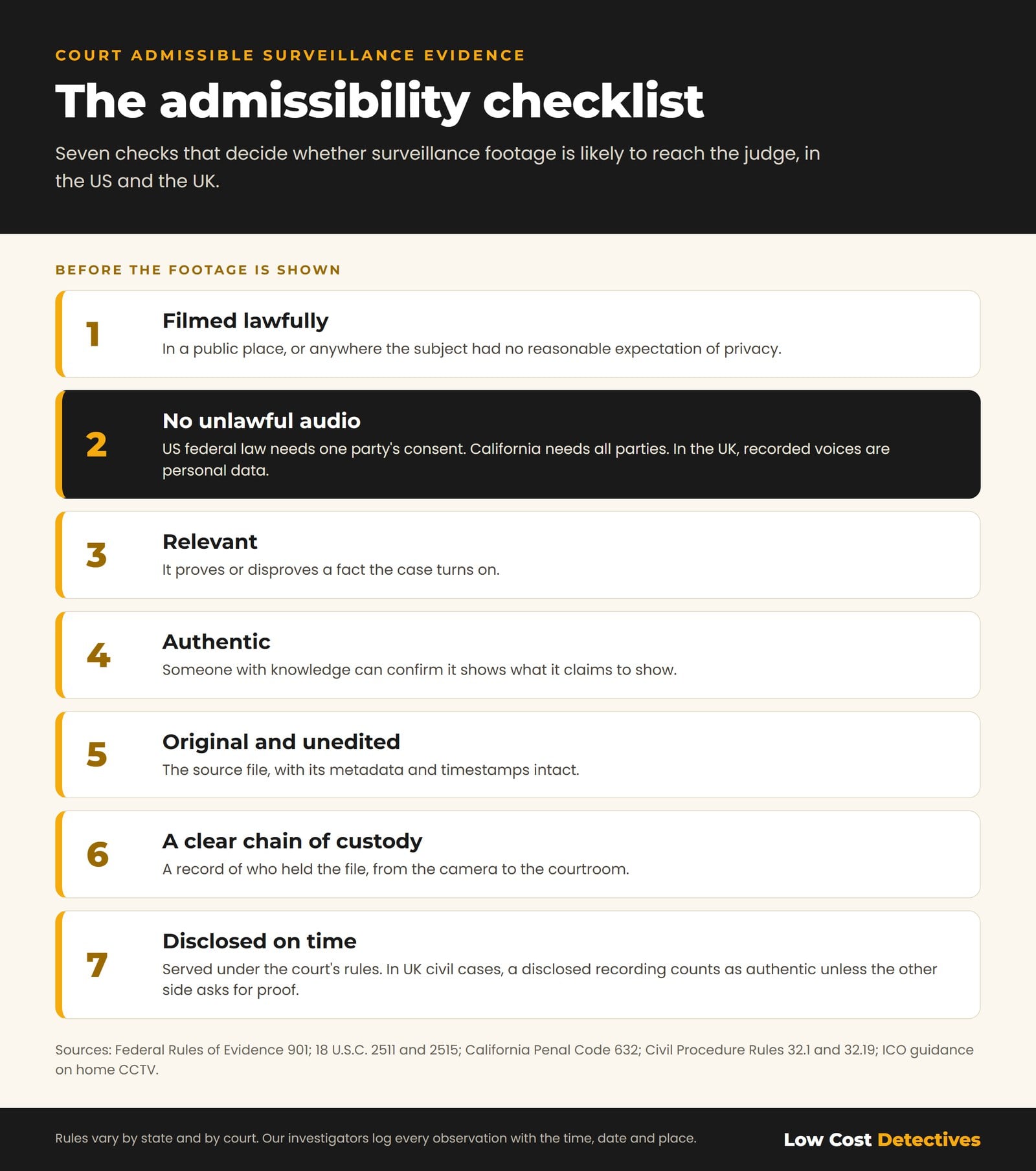
Courts in the US and the UK ask the same basic questions before footage is shown. Was it filmed lawfully? Is it relevant? Can someone confirm it is genuine? Has it stayed unedited since the day it was recorded? Court admissible surveillance evidence answers each one. A weak answer gives the other side a reason to challenge it.
- Filmed lawfully. It was shot in a public place, or where the subject had no reasonable expectation of privacy.
- No unlawful audio. Recorded conversations bring in consent and wiretap laws that silent video avoids.
- Relevant. It proves or disproves a fact the case turns on, which gives it probative value.
- Authentic. A witness with knowledge can confirm it shows what it claims to show.
- Original and unedited. The source file survives with its metadata and timestamp intact. Trimmed clips raise questions about integrity and tampering.
- A clear chain of custody. A record shows who held the file, from the camera to the courtroom. Professional evidence collection keeps that record from the first frame.
- Disclosed on time. It is served under the court’s disclosure rules, not held back for a surprise at trial.
Court admissible surveillance evidence matters in personal injury claims, workplace disputes, and civil and criminal investigations. It matters just as much in family courts, where child custody investigations often rest on careful observation.
Can Video Evidence Be Used in Court in the US? Evidence Rules and Consent Laws
Yes. Video evidence can be used in court in the US when it is relevant, authentic, and lawfully recorded. Private footage is not blocked by the Fourth Amendment, which only limits the government. The real risks are audio recorded without the consent the law requires, and filming where someone expects privacy.
Private Footage and the Fourth Amendment
In 1921, the Supreme Court held that the Fourth Amendment restrains government, not private individuals. The case was Burdeau v. McDowell, and courts still rely on it. So footage from a private investigator is not excluded simply because no warrant was involved. It still has to pass the rules of evidence to become court admissible surveillance evidence.
Audio Is the Weak Point
Federal law lets a private person record a conversation if they take part or one party consents. That is the one-party consent rule in 18 U.S.C. section 2511. A hidden camera recording strangers’ conversations usually has no consenting party at all. If the interception was unlawful, 18 U.S.C. section 2515 bars its contents from evidence.
Some states go further and require all-party consent. In California, recording a confidential conversation needs the consent of all parties. Evidence gathered in breach of that rule is not admissible in any judicial proceeding. This is why silent video tends to be safer than video with sound. Legal surveillance guidelines differ from state to state, so check local law before any device records sound.
No ICO: The US Privacy Patchwork
The US has no national equivalent of the ICO or of GDPR. The Congressional Research Service has noted that no single federal law comprehensively regulates consumers’ personal data. Congress has still not passed one. Instead, the Federal Trade Commission and state laws fill the gap. California’s Privacy Protection Agency, for example, enforces the California Consumer Privacy Act.
Most states also require private investigators to be licensed, according to the Bureau of Labor Statistics. Our surveillance across North America works within each state’s rules.
UK Courts, UK GDPR, and the ICO: Why Footage Can Be Admitted and Still Cost You
In the UK, court admissible surveillance evidence is largely a matter of judicial discretion. Civil judges can admit footage even when it was obtained improperly. Civil Procedure Rule 32.1 gives them the power to exclude it, but not a duty. The cost lands on whoever gathered it instead. It can be a costs order, a data protection claim, or a harassment finding.
The Warwick Case: Admitted, Then Paid For
In Jones v University of Warwick, an investigator for the university’s insurers posed as a market researcher. Once inside the claimant’s home, the investigator filmed her with a hidden camera. The Court of Appeal called the insurers’ conduct “improper and not justified.” It still let the footage stand, and ordered the defendants to pay the costs of the dispute.
Footage can survive a bad method, but the bill for that method can land on you.
When UK GDPR Applies to Your Camera
The Information Commissioner’s Office is clear on home CCTV. If a camera records beyond your property boundary, data protection law applies. Consent is rarely needed, but you need a legitimate reason and must respect other people’s privacy rights. Voices count as personal information too.
In Fairhurst v Woodard, decided in 2021, a neighbor’s camera setup went too far. The doorbell’s video struck a fair balance, but its audio range of over 60 feet was disproportionate. A driveway camera was also unlawful, and the harassment claim succeeded.
Evidence Gathered for Legal Proceedings
The Data Protection Act 2018 lifts key GDPR rules where disclosure is needed for legal proceedings. That lets footage be shared with lawyers and the court. In civil proceedings, a disclosed document is treated as authentic by default. The other side must serve notice if it wants it proved at trial.
At Low Cost Detectives, our surveillance across Europe is planned around these rules from the start.
US and UK Rules Side by Side
| Question | United States | United Kingdom |
|---|---|---|
| Who regulates privacy? | No single federal law. The FTC and state agencies fill the gap. | The ICO, under UK GDPR and the Data Protection Act 2018. |
| Recording conversations | One party’s consent federally. Some states, such as California, need all parties. | Intercepting a call in transmission is an offense (Investigatory Powers Act 2016). |
| Improperly obtained evidence | Unlawfully intercepted audio is barred. The Fourth Amendment does not bind private parties. | The judge decides (Civil Procedure Rule 32.1). Admission can come with a costs penalty. |
| Proving it is genuine | Federal Rule of Evidence 901: proof the item is what it claims to be. | Civil Procedure Rule 32.19: disclosed documents count as authentic unless proof is demanded. |
Why DIY Footage Fails Where Professional Surveillance Holds Up
Home footage usually fails on how it was made, not on what it shows. Common problems include recorded audio and cameras that cover a neighbor’s property. Others are clips trimmed on a phone, and no record of who handled the file. Each one hands the other side an easy challenge.
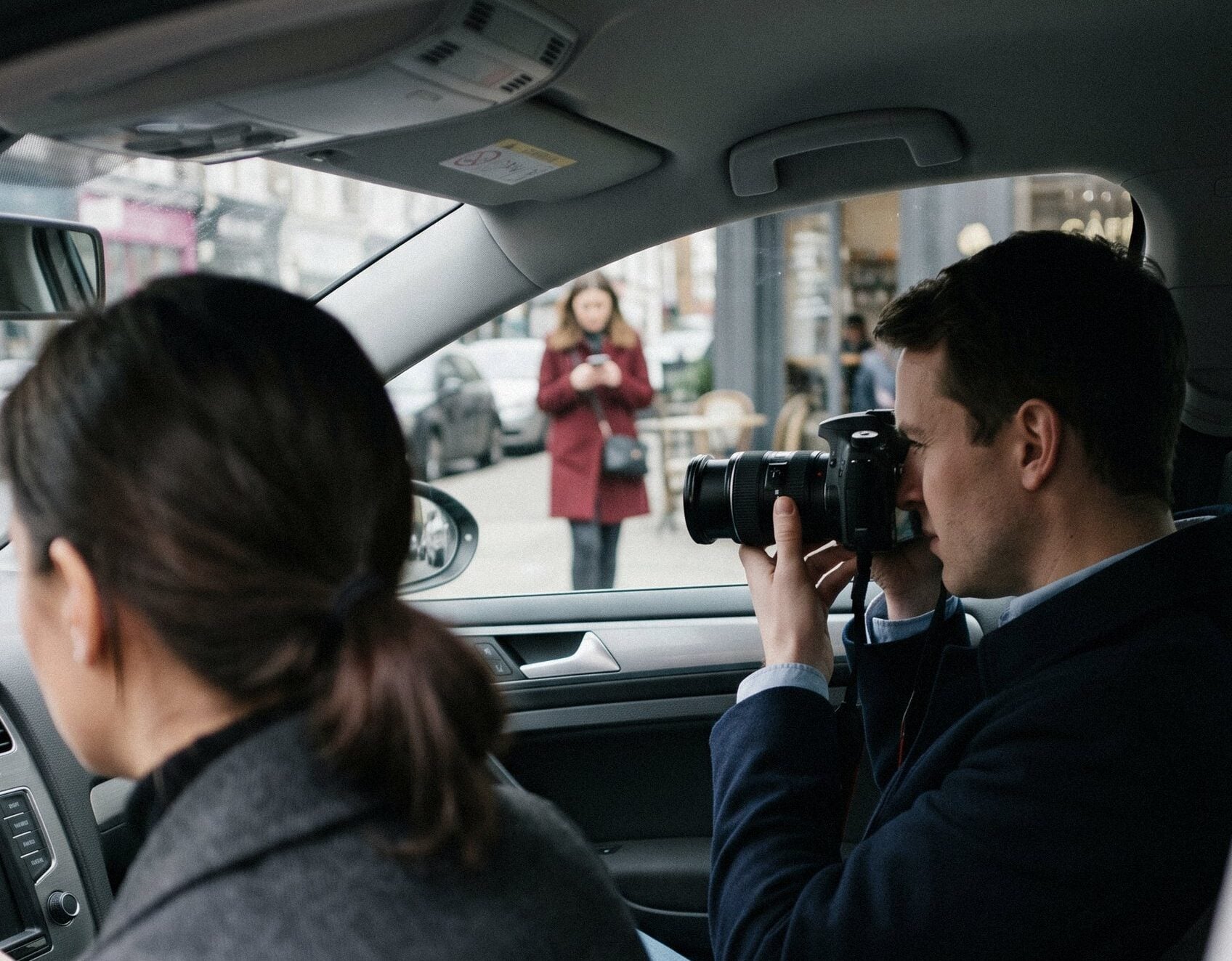
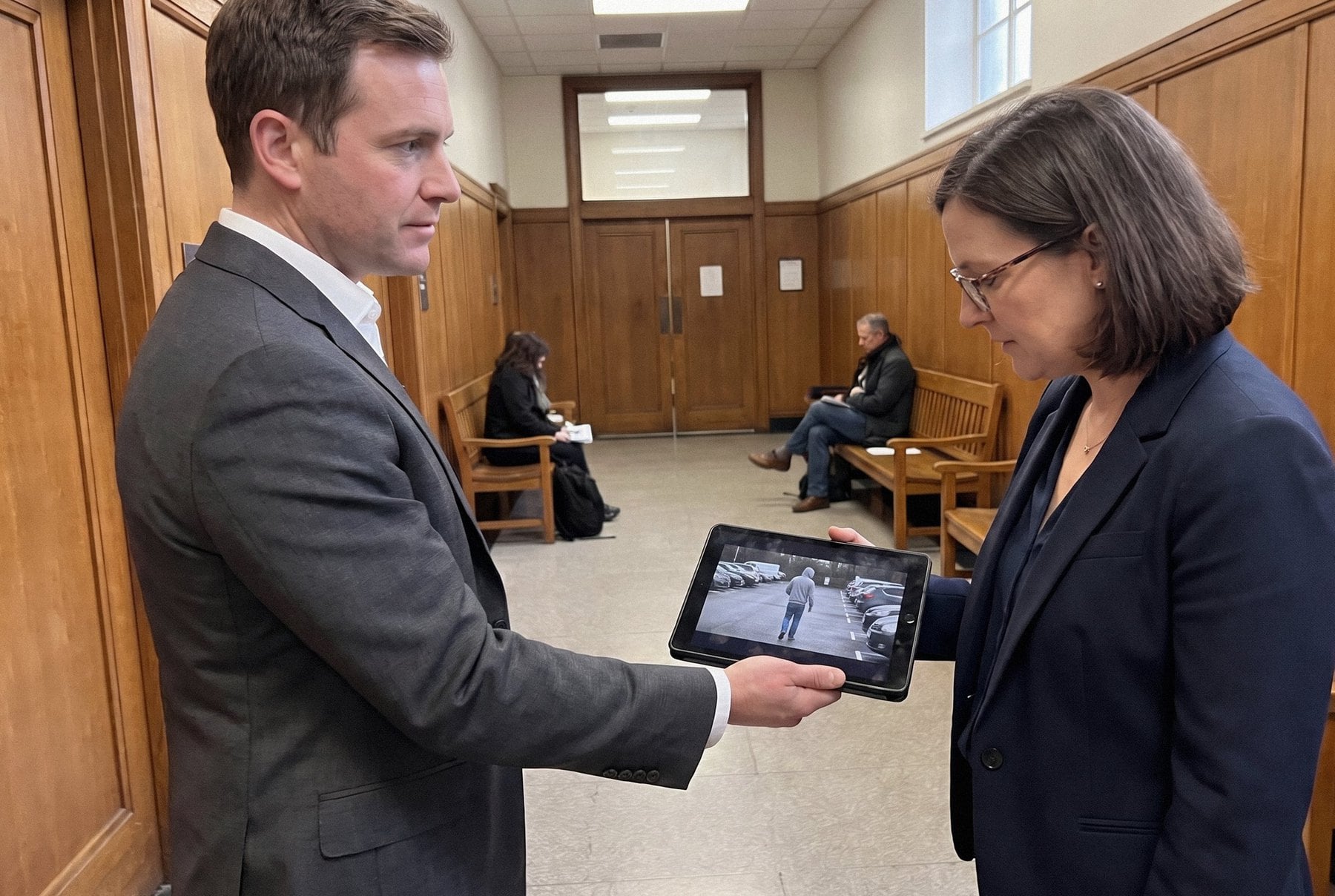
Our surveillance private investigator service is planned around court admissible surveillance evidence. A two-person team with a vehicle watches the subject from public places. Every observation is logged with the time, date, and place. You then receive a written evidence report, with photos or video where the law allows. Covert surveillance means the subject is never approached or alerted, so the footage shows ordinary behavior.
Professional investigators work within the private investigator rules of law wherever the case takes place. In some countries, the law limits us to written observation, and we follow it. Low Cost Detectives handles surveillance in 170+ countries through 300+ branches. Read how professional surveillance works for the methods behind each report.
We also work alongside lawyers through our legal and litigation support service. If you need footage for a claim or dispute, speak to our investigators before anyone presses record.
Get the Evidence Right Before You Need It
Court admissible surveillance evidence starts long before a hearing date. It depends on where the camera stood, whether it recorded sound, and how the file was kept. The US and UK take different routes, but the checklist is the same.
At Low Cost Detectives, we plan every surveillance job around that checklist. Talk to our team in confidence about your case, and we will explain what can be gathered lawfully.
Frequently Asked Questions About Court Admissible Surveillance Evidence
Can video evidence be used in court without the subject’s consent?
Often, yes. Silent video filmed in a public place usually needs no consent from the person filmed. In the UK, the ICO says consent is rarely required for home CCTV. Audio recording is different: US federal law needs one party’s consent, and some states need everyone’s. Filming inside private spaces carries far more risk.
Is a private investigator’s surveillance evidence admissible in court?
It can be. An investigator’s footage becomes court admissible surveillance evidence when it passes the usual tests. It must be relevant, authentic, lawfully obtained, and properly disclosed. A clear surveillance log helps. At Low Cost Detectives, every observation is recorded with the time, date, and place. The evidence report is ready for your lawyer to review.
Can doorbell or home CCTV footage be used in court?
Yes, doorbell and CCTV footage can be used when it is relevant and genuine. In the UK, cameras that record beyond your property boundary bring in data protection law. A 2021 court found one doorbell’s audio range disproportionate. Point cameras at your own property, avoid recording sound you do not need, and keep the original files.
Does GDPR stop surveillance footage being used in a UK court?
Not on its own. A UK civil judge decides whether to admit evidence, even footage gathered improperly. The Data Protection Act 2018 also allows disclosure for legal proceedings. A breach can still lead to a separate claim against whoever filmed, as a 2021 doorbell case showed. Keep cameras on your own property to avoid that risk.
Can edited or trimmed footage be used as evidence?
Edited footage is much harder to rely on. Courts check authenticity and want to know the clip shows what really happened. Trimming invites questions about what was left out. Keep the original file with its metadata and timestamps intact. Record who has handled it since, so its chain of custody stays clear from capture to court.