
Infidelity statistics are easy to find and hard to trust. One site says half of all partners cheat, while another says one in five.
We went back to the source data for these infidelity statistics. The Low Cost Detectives analysis of the US General Social Survey covers 30 years of answers. We add the newest UK and Australian surveys, and explain what each one measures.
Low Cost Detectives has handled infidelity cases in 170+ countries for over 30 years. Here is what the numbers really say.
Infidelity Statistics at a Glance
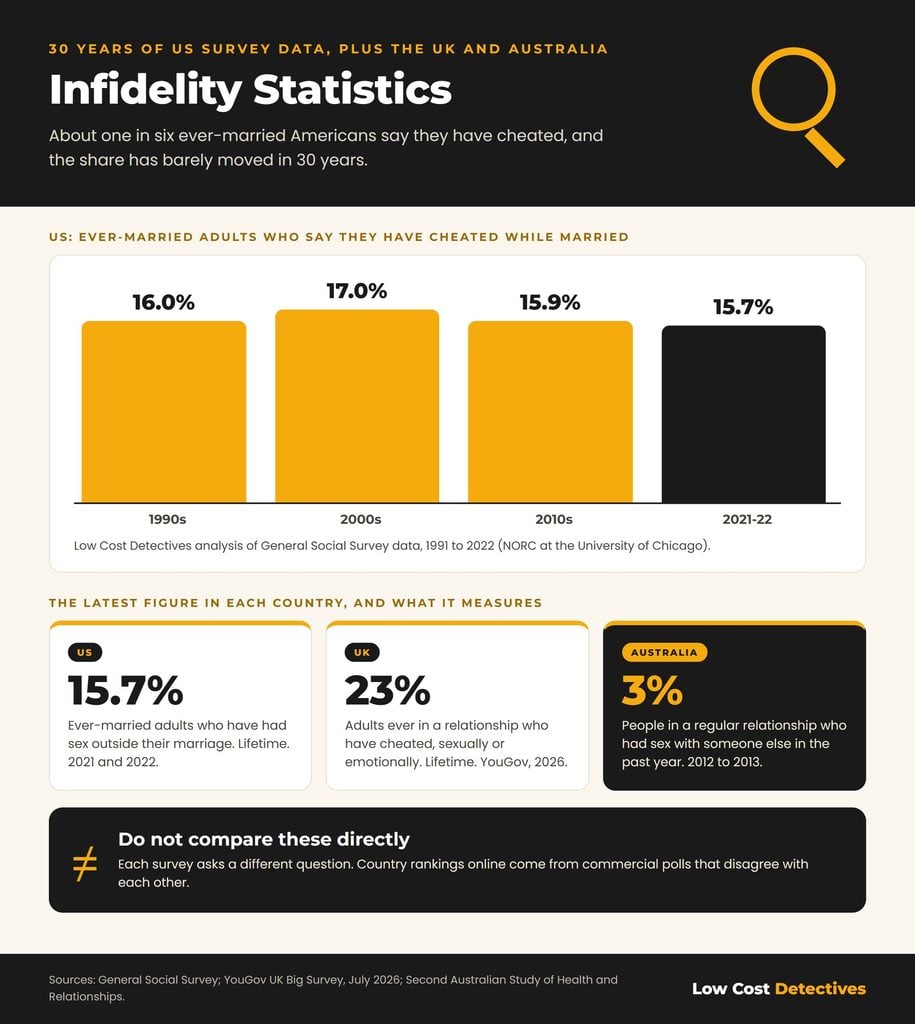
- US: about one in six ever-married Americans (15.7%) say they have cheated while married.
- Steady for 30 years: the US figure was 16.0% in the 1990s and 15.7% in 2021 and 2022.
- UK: 23% of Britons who have been in a relationship say they have cheated.
- Australia: 3% of people in a regular relationship had sex with someone else in the past year.
- Gender: 17.5% of ever-married US men and 14.1% of women report cheating.
- Divorce: divorced Americans are almost three times as likely as married ones to report cheating.
These figures measure different things, so they cannot be compared directly. The sections below explain each one.
How Many People Cheat in the US?
The best US source is the General Social Survey, run by NORC at the University of Chicago. Since 1991, it has asked ever-married adults one question. Have they had sex with someone other than their spouse while married?
30 Years of Survey Data
Our analysis of the survey data shows a remarkably stable picture. Roughly one in six ever-married Americans say they have cheated.
- 1990s: 16.0%
- 2000s: 17.0%
- 2010s: 15.9%
- 2021 and 2022: 15.7%
So these infidelity statistics do not show a modern epidemic. The Survey Center on American Life reached the same view, calling the rates “relatively stable.” Yet 57% of young women and 44% of young men believe infidelity is very or extremely common. Its 2023 national survey found 46% of women and 34% of men had been cheated on.
One caveat: in 2021, the survey moved mostly online because of COVID. That change may have shifted some answers.
Men, Women, and Age
Men still report more infidelity than women. But the gap is the narrowest of any decade measured. In 2021 and 2022, 17.5% of ever-married men and 14.1% of women said they had cheated. Our guide to who cheats more, men or women covers the gender gap in depth.
Age matters too, because the question covers a whole married life. The share rises from 13.8% of people in their thirties to 22.3% of those aged 70 and over.
Infidelity Statistics in the UK, Australia, and Worldwide
United Kingdom
The newest UK figures come from YouGov’s 2026 survey of 1,882 Britons. Almost a quarter (23%) of those who have been in a relationship admit cheating on a partner. An earlier YouGov poll in 2015 put the share admitting an affair at one in five adults.
That includes 17% who cheated sexually and 18% who cheated emotionally. Some 12% have done both. Attitudes are strict: 41% say it is never reasonable to take back a partner who cheated.
The UK infidelity statistics use a broader definition than the US survey. They include emotional affairs and any relationship, not just marriage.
Australia
Australia’s best source is the Second Australian Study of Health and Relationships, a national survey of 20,094 adults. In its 2012 to 2013 round, 97% expected sexual exclusivity in their regular relationship.
Only 3% reported sex with someone else in the past year. That is a one-year figure, so it is far lower than lifetime measures. Most Australians (83%) also said sex outside a committed relationship is unacceptable.
Why Infidelity Rates by Country Disagree
Many sites rank countries by infidelity rates, often with Thailand or Denmark near the top. Those tables usually draw on commercial online polls, not national surveys. They also disagree with each other. One ranking puts Denmark at 46%, and another at 22%.
So treat global infidelity statistics with care. The honest answer is that no reliable worldwide figure exists. National surveys with clear questions are the best guide.
Emotional Affairs, Dating Apps, and Divorce
Emotional Affairs
Not all cheating is physical. In an Institute for Family Studies survey, 76% said a secret emotional relationship counts as infidelity. Among ever-married adults, 7% reported an emotional-only affair, and 10% reported both kinds.
Dating Apps and Social Media
Dating apps make straying easier to arrange. Another survey by the same institute found 11% of married adults under 40 use dating apps. In the UK, 80% say using a dating app in a relationship is cheating.
Worried about a partner’s online life? The Low Cost Detectives online loyalty test shows how they respond to new contact. Speak to our investigators in confidence.
Repeat Cheating and Divorce
Past behavior is a real signal. A study of serial infidelity tracked people across two relationships. Those who cheated in the first were three times more likely to cheat again.
Infidelity is also closely tied to divorce. It was the most cited reason in a major national study of divorced Americans. In another study, infidelity was the most common “final straw,” named by 24% of those who gave one. In our analysis, 29.9% of divorced Americans report cheating, against 11.2% of married ones.
Steady Numbers, Personal Questions
Infidelity statistics show that most partners stay faithful, and that the rate has barely moved in 30 years. But numbers cannot tell you what is happening in your own relationship.
If something has changed, our free suspicious behavior check is a good first step. For answers, Low Cost Detectives runs discreet infidelity investigations in 170+ countries. We have a 95% global success rate. Contact us in confidence, as part of our wider relationship investigations work.
Frequently Asked Questions About Infidelity Statistics
What percentage of people cheat?
Infidelity statistics depend on the survey and the definition. In the US, about one in six ever-married adults (15.7%) say they have cheated while married. In the UK, 23% of people who have been in a relationship admit cheating, including emotional affairs. Lifetime figures are always higher than one-year figures.
Who cheats more, men or women?
Men, but the gap has narrowed. In 2021 and 2022, 17.5% of ever-married US men said they had cheated, against 14.1% of women. In earlier decades, the gap was close to nine points. Under 40, women now report slightly higher rates, though that sample is small.
Which country has the highest infidelity rate?
No reliable answer exists. Online rankings often put Thailand or Denmark at the top. But they rely on commercial polls that disagree with each other. National surveys use different questions, so their figures cannot be compared directly. Treat any global ranking as a rough talking point, not a fact.
How many marriages end because of infidelity?
There is no single figure, but infidelity is one of the most common reasons people give. It was the most cited reason in a major national study of divorced Americans. In another study, 24% of people who named a “final straw” said it was infidelity.
Do people who cheat once cheat again?
Some do. A study of serial infidelity tracked people across two relationships. Those who cheated in the first were three times more likely to cheat again. Those who suspected a partner were four times more likely to suspect the next one. Past behavior is a signal, not a certainty.
Is infidelity increasing?
Not according to the best US data. In the 1990s, 16.0% of ever-married Americans said they had cheated. In 2021 and 2022, the figure was 15.7%. What has changed is perception and opportunity. Social media and dating apps make contact easier, and cheating stories spread fast online.